
Guest reading progress stays in this browser and is not synchronized to your account automatically. Use the learning panel to include browser marks and save them explicitly. Clearing site data removes browser marks.
Your learning notebook
Save courses and review situations deliberately. Load your account records on another device when you want to continue.
Bookmarks and review choices stay in this browser until you load and save an account. Answers and time spent reading are not recorded.
Saved courses
Saved situations to revisit
Find your marked situations by title or topic, then open the original question and explanation.
Your review choices will appear here when this learning view is ready. Use the account controls above to load account choices.
No situations are marked for review in this learning view.
No saved situation matches these filters. Clear the search or choose all topics.
Identification practice
Land access practice
Field decisions practice
Harvest care practice
Useful reading before this lesson
Start with these guides for background and preparation. You can open any guide at any time.
Brief the outing · Moose
Observation beside wet woodland from verified firm ground, with wetland access and recovery capability kept explicit.
An original planning summary to use with the full lesson. Check current law, permission, identification and local conditions separately; this card does not establish readiness or eligibility.
Open the briefing and field checks
Three tools and their jobs
- Binoculars: examine woody edges without approaching uncertain banks.
- Firm-ground route sketch: mark return and the edge of what was checked.
- Recovery/receiving worksheet: list needed people, equipment and a usable route before committing to a hunt.
Rehearse the complete visit
- Before leaving: Start with the full return and recovery question: select a viewpoint reachable without an unverified wet crossing.
- On arrival: Inspect footing from the checked approach; old tracks and a familiar shoreline do not confirm current ground strength.
- Brief and organise: Describe only visible edges and observations, keeping water and soft ground outside the walking plan.
- Return and review: Return along firm verified ground and record any capability gap that must be solved before a later visit.
Two avoidable mistakes
- A map line beside water does not confirm a usable shoreline route.
- Finding promising habitat can distract from an impractical recovery plan.
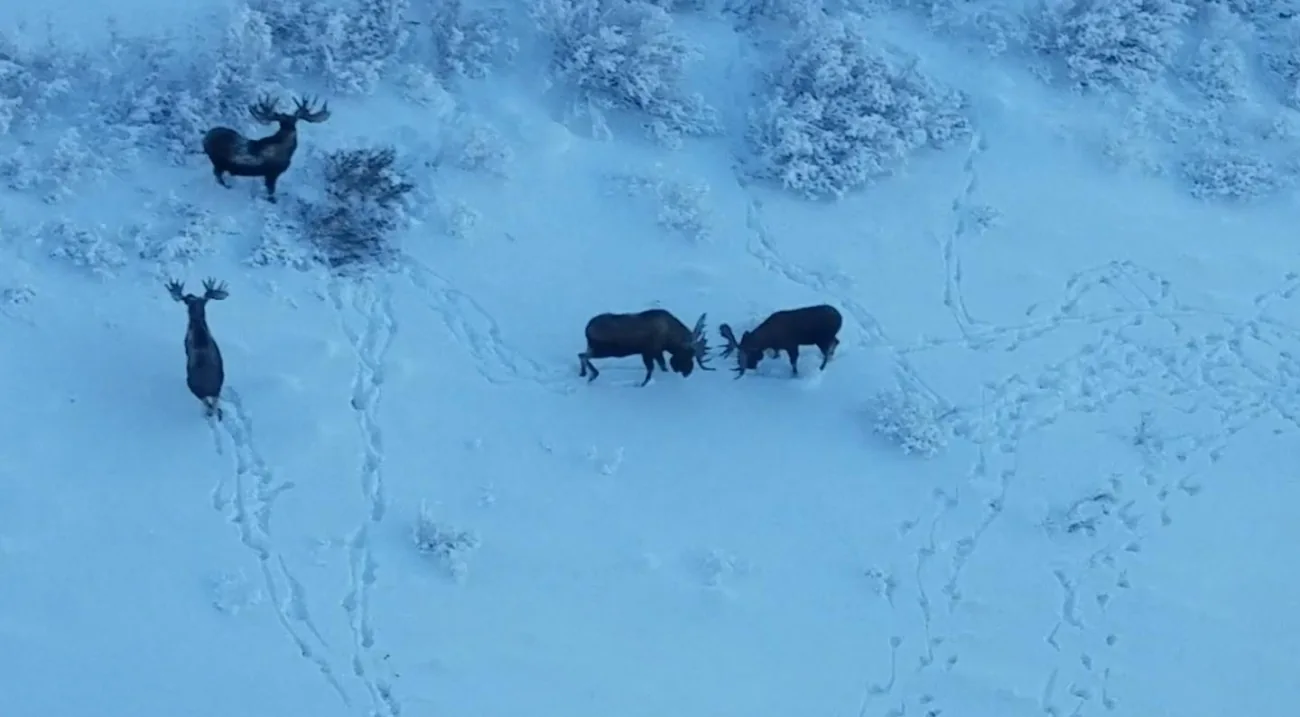
Real species reference photograph from the credited source. This is one view of an individual, not a local sighting or evidence of current animal numbers. Use the lesson to connect observations with a checked field plan.
Image credit: USFWS · Public Domain · View image sourceWhat you will learn
- Compare young growth, forest cover and wetland margins without assuming a current sighting.
- Distinguish a safe observer route from an animal’s use of wet ground.
- Set clear limits for close encounters, difficult access and retrieval capacity.
An original SKHunter learning guide
Observe the wetland edge from firm, checked ground
Keep the interesting habitat and the ground you can safely use as two separate parts of the plan.
Conceptual sketch · no scale, coordinates, parcel boundaries or suggested destination. The walking route is assumed checked for this example; every real approach needs its own access and ground checks.
Read the sketch
- A · checked observation point
- R · return / meeting point
- Dashed green line · checked walking route
- Hatched area · not checked; outside this plan
Habitat shapes: Blue: water / wet ground. Green: woody edge. Light right-hand area: the example’s checked observation side.
What is actually observed
A gives a view of one part of the woody margin while water and other shorelines remain uninspected.
What still needs evidence
Suitable-looking cover does not establish a Moose location, a usable shoreline or a retrieval route.
Work through the example
- 01
Start with the return
Locate R and the checked approach before choosing where to watch. A longer detour needs its own preparation.
- 02
Choose firm observation ground
Use A on ground already checked by the group. Describe woody cover and the visible water margin without stepping closer for a better view.
- 03
Keep water out of the route
The checked path stays on the example’s firm side. Unchecked shore, water and soft ground remain outside the plan.
- 04
Reassess before another visit
If the view is insufficient, retain that limitation and return; plan a different lawful viewpoint separately.
Rehearse your own decision
Describe the evidence first, then decide what needs checking before another visit.
- Can you explain the return without relying on crossing water or soft ground?
- Which habitat features were observed, and which animal-use ideas are still guesses?
- Could the group manage a lawful retrieval without improvising a wetland entry?
Map a habitat mosaic and its accessible edge
Moose can use young forest, woody growth and wetland vegetation, with seasonal differences. On your checked parcel, mark young growth, thicker forest and wet margins as separate features. Add the places you have actually inspected from firm ground and leave mapped water or vegetation as unverified where appropriate. Choose a small comparison, such as whether two authorised viewpoints show different parts of a regenerating patch. Do not turn an old clearing or a wetland symbol into a claim that Moose are present now.
Choose viewpoints for people, not for Moose
A Moose may use terrain that your group cannot cross. Inspect the footing and return to a stable observation point instead of following hoof marks toward a soft shore or channel. Use binoculars to check a dark shape, then compare the visible outline, shoulder, head and other features without relying on a firearm sight. Mark exactly what vegetation hides. Keep the animal’s approximate location separate from your observer point, and preserve the uncertainty when the view never becomes useful.
- A mapped wetland edge is not a firm walking route.
- Do not enter water or ice for a clearer observation.
Turn browse and prints into questions
Record a browsed stem, track or pellet group with a photograph, scale and surface context when safe to do so. Distinguish a photographed feature from its proposed explanation: a broken stem may have several causes, and a deep print changes with substrate. Do not infer precise freshness, sex or a specific animal from size alone. Compare several independent observations over time, and keep weather you witnessed separate from weather you merely assume occurred. Avoid handling scat or disturbing vegetation to make a more convincing record.
Give an encounter room to remain uneventful
Before entering a short leg, identify where the group can pause or withdraw. Keep space around any Moose and never place people between animals, particularly a cow and calf. Do not approach a stationary animal for a better photograph or assume it will move out of the path. When your presence changes its attention or blocks its movement, stop the approach and create distance without surrounding it. End the leg if a calm retreat or the intended return cannot be maintained. Learn local wildlife-encounter guidance before relying on a forest outing.
Link short forest legs with recognisable returns
Name clear checkpoints such as a verified junction or distinct opening, then rehearse finding them in both directions. Forest tracks can branch or become less obvious on the return. Record your direction changes and keep essential navigation and communication with each person. A track on a map does not establish public access, vehicle permission or a usable surface. If a junction is uncertain, stop there and resolve it rather than continuing until the group is more deeply committed. Keep a short, checked alternative for poor visibility or wet footing.
Make retrieval capacity a destination filter
A Moose outing needs a serious discussion of people, terrain, lawful access, handling skills, cooling arrangements and the work of getting a large animal out. Before selecting a farther destination, walk the actual return and identify every narrow, soft or steep section. Discuss who can provide trained help and what changes would cancel the plan; do not assume a vehicle can be brought to any pin. Review current Saskatchewan requirements and CWD arrangements for the actual outing. An observation visit can end successfully with an honest conclusion that the destination exceeds present capacity.
- Keep animal handling and cooling training separate from this observation lesson.
- If the route cannot support the group’s return and retrieval plan, choose a closer site.
Case: tracks disappear into a soft wetland margin
A track sequence leaves a firm forest route. The map shows an opening beyond it, but the shore, channel and return load have not been checked.
Put it into practice
- Photograph the visible track context from the stable route without stepping into soft ground.
- Record the identification and age of the sign as uncertain where unsupported.
- Keep the wet margin outside the current walking plan.
- Observe from the checked point or return to a previously inspected alternative.
- Use the debrief to review access, trained help and a realistic retrieval destination.
Common mistakes to avoid
Long legs make the route suitable for people
Animal use does not establish stable footing, a crossing or a safe return.
A quiet animal invites a closer view
Leave room for movement and withdraw before the group creates pressure.
A big vehicle solves recovery
Check the whole lawful route, handling skills, people and cooling capacity first.
Moose tracks enter soft ground beside a channel. What do they establish?
- A safe human crossing.
- A suitable place to drive.
- Evidence to record; the group still needs its own checked route.
Show the answer and explanation
Answer: C. Evidence to record; the group still needs its own checked route.
The animal’s passage does not inspect the ground for people or provide access and retrieval capacity.
Elk and Moose: keep provisional labels separate
Two fictional notes use different provisional names. This exercise keeps Elk and Moose as separate identification questions; neither name substitutes for evidence.
Fictional teaching example, not a parcel sighting or current conditions report. Example times are not hunting-hour guidance.
Scroll across the table to compare each observation with its interpretation and next check.
| Time | Direct observation | Count and scope | Interpretation / uncertainty | Next check |
|---|---|---|---|---|
| One animal is visible at the first landmark; the note is provisionally labelled Elk. | 1Observed count One visible animal; Elk label unconfirmed. | The count concerns the view. The provisional label is a question, not a verified Elk identification. | Keep the descriptive note and resolve the identification using the linked Elk lesson. | |
| One animal is visible later at another landmark; the note is provisionally labelled Moose. | 1Observed count One visible animal; Moose label unconfirmed. | A second provisional name does not validate either name or prove a different individual. Do not combine the records into an Elk or Moose total. | Compare each note with its own reference and retain uncertainty about both species and repeats. | |
| A sound is recorded behind cover without a visible animal. | Unknown Unidentified sound; animal count unknown. | The sound does not establish a species or a numerical count. It is not another confirmed animal. | Keep a separate sound note without assigning Elk, Moose or zero animals. |
Counts belong to the stated view or sample. Repeated views may include the same animals; these rows are not summed into a unique population total.
A concrete next action
Review identification, repeat status and route separately. A useful next action can be another checked observation or ending the visit with uncertainty recorded.
Pause and reflect
What is wrong with reporting “two Elk/Moose plus one heard”?
Read the reasoning
It merges distinct unconfirmed species labels, assumes the two views contain different individuals and turns a sound into an animal count. Keep the three evidence records separate.
Terms on this page
Open a term for its meaning, a common mix-up and the existing guide. English terms and acronyms are retained.
inference
An explanation or estimate drawn from observations, rather than another separately observed fact.
Common mix-up: A confident file name, habitat label or repeated copy does not add a new observation.
unknown count
A record for which no reliable numerical animal count was obtained.
Common mix-up: Unknown is not zero. Uncertain species identity does not by itself erase a number actually seen.
retrieval / recovery
The separate plan for finding and bringing back a bird or animal described by an outing.
Common mix-up: A return plan for people does not describe every animal-retrieval task; keep recovery limits visible.
Current checks and official context
Match the current Saskatchewan opportunity
Before a hunting outing, match the actual species, person, licence, WMZ, method and date with current official tables and later updates. The landscape examples do not determine eligibility or an open season.
Keep biology, access and health checks distinct
Out-of-province wildlife references explain biology, not Saskatchewan hunting law. Confirm the whole route and land conditions separately, then review current CWD and handling arrangements for the actual outing.
Pocket lesson card
Public teaching summary for review and offline reading. It contains no actual trip records, permissions, parcel conditions or coordinates. Use the full lesson and current official guidance for your own plan.
Save the HTML for offline text. Use your browser’s Print menu to print the opened card; online links require a connection.
Read the pocket card
Moose · field preparation
Before leaving
- Mark firm observation ground, water edges and unconfirmed crossings.
- Review the available people, equipment, access and cooling arrangements.
At the location
- Keep the return independent of an assumed shallow crossing.
- Describe actual views separately from sounds or habitat guesses.
Return
- Close the return check-in and collect equipment and waste.
- Finish by the checked return rather than extending into uncertain ground.
Review
- Choose one missing piece of evidence to check next time.
- Leave sound-only animal counts unknown and species unassigned.
A fictional observation example
Fictional example: a sound is heard behind cover without a visible animal. It is an unknown count, not an additional confirmed Moose.
Full reviewed lesson · onlineSource lesson editorial review: 2026-11-02
Turn this lesson into your next outing
Review the date, species, starting template and linked day plan in an editable preparation draft. You choose what to add and save.
Prepare your own trip
Review a preparation draftContinue learning
Big game after the harvest: plan cooling, transport and a traceable handoverTry a practical situation
A large animal at the timber edgeOpening a draft does not create a saved checklist. A checked item records your own review, not permission or an open season.
Scenario practice
Put your field decisions into practice.
Try 24 situations across identification, access, field adjustments and harvest care. Compare your choice with the explanation, then revisit the relevant lesson.
Original sources
- Minnesota DNR · Moose biology and habitat
- New York DEC · Moose habitat and behaviour
- Government of Saskatchewan · Current Hunters Guide and updates
- Government of Saskatchewan · Hunters Extras, access and ethical hunting
- Government of Saskatchewan · Current CWD testing and sample arrangements
Use this as a planning guide. Check current official requirements and site conditions before travelling.
Help improve this guide
Tell the editor about something on this public page that needs attention.