
Guest reading progress stays in this browser and is not synchronized to your account automatically. Use the learning panel to include browser marks and save them explicitly. Clearing site data removes browser marks.
Your learning notebook
Save courses and review situations deliberately. Load your account records on another device when you want to continue.
Bookmarks and review choices stay in this browser until you load and save an account. Answers and time spent reading are not recorded.
Saved courses
Saved situations to revisit
Find your marked situations by title or topic, then open the original question and explanation.
Your review choices will appear here when this learning view is ready. Use the account controls above to load account choices.
No situations are marked for review in this learning view.
No saved situation matches these filters. Clear the search or choose all topics.
Identification practice
Land access practice
Field decisions practice
Harvest care practice
Useful reading before this lesson
Start with these guides for background and preparation. You can open any guide at any time.
Brief the outing · Ducks
A visit from a checked firm, dry bank; this brief does not cover wading, boating, ice travel or water rescue.
An original planning summary to use with the full lesson. Check current law, permission, identification and local conditions separately; this card does not establish readiness or eligibility.
Open the briefing and field checks
Three tools and their jobs
- Binoculars: study the edge without approaching soft ground for a better view.
- Visible bank/return reference in the notebook: relocate the checked exit.
- Dry spare layers: keep a change protected, without treating it as permission to enter water.
Rehearse the complete visit
- Before leaving: Plan the whole visit from verified dry ground and identify a usable return that does not depend on crossing water.
- On arrival: Compare the actual bank, water level and footing with the previous visit before unloading.
- Brief and organise: Agree on the limit of the dry position and a recovery plan that the team can actually carry out; do not improvise a water entry.
- Return and review: Leave before the route becomes unreliable; record the bank condition and missing recovery capability rather than hiding the problem.
Two avoidable mistakes
- A familiar bank may have changed since the last visit.
- Waterproof clothing does not prove footing, access or recovery capability.
Illustrative equipment and concealment examples. Teaching illustration · not to scale · no distances implied
Image credit: SKHunter · AI-generated teaching illustrationWhat you will learn
- Separate a usable shore position from water that merely looks shallow or accessible.
- Choose and inspect a small floating-decoy setup with a clear arrival pocket and an immediate recovery plan.
- Use bird responses and changing drift to decide when to adjust, withdraw or stop.
An original SKHunter learning guide
The bank, the water and the permission are separate checks
This lesson starts after personal preparation and access permission. It covers hunting from verified stable land beside a small wetland, not boat operation, ice travel or entering the water. A water polygon on a map cannot show a firm bank, safe footing, current depth or permission for every part of the shore. Read the actual site before unpacking.
Check the named-water closures in Saskatchewan’s current Hunters Extras, including the listed 500-metre restrictions and separate year-round closures. An open general season or a landholder’s consent does not remove these rules. Observe actual daytime use from an authorised position, distinguish resting or feeding visits from birds merely passing, and avoid pushing a roost to manufacture activity.
Recovery determines the usable setup
Floating decoys need appropriate lines, attachments and anchors; a field decoy is not automatically a floater. Begin with a number the party can handle, rather than a fixed shopping target. Before placement, identify where birds might fall and how wind or current could carry them. Suitable means for prompt recovery must already be available for that whole likely area.
For this shore-only course, deploy and retrieve equipment using a method that can be operated from verified footing without entering the water or leaning over an unstable edge. Test the method under today’s conditions before hunting. If the likely recovery area exceeds the party’s safe, authorised capability, choose another position or cancel. A trained dog, waterproof clothing or a flotation aid does not make an unsuitable situation acceptable.
Give the arrival space a clear boundary
Ducks commonly approach into the wind, but the shoreline, shelter and birds’ recent use may alter their approach. Keep an open pocket among a few loose groups on water that the party can manage. The hidden position stays on firm land with room to observe and identify birds; it is not placed wherever a symmetrical U looks best.
Watch comparable approaches before diagnosing a refusal. Check exposed people, reflections, blocked space and drifting gear before adding calling or motion. Make one change during a group pause, then observe again. Water conditions can change faster than the decoy pattern: a spreading wave line, new ice, a slipping anchor or a weakened exit can be a reason to end the outing rather than improve the spread.
Intermediate fieldcraftAfter permission · from a checked dry bank
A practical workflow for prepared, eligible participants who remain on firm, authorised shore. The small-water arrangement is an original teaching example, not a route into the wetland. Check current closures, identify the actual species and confirm that likely falls and drift can be recovered promptly before starting.
Choose a workable kit
| Item | Priority | What it does | Practical choice / alternative |
|---|---|---|---|
| Permission record, closure reference and offline shore map | Core kit | Mark authorised entry, firm positions, excluded areas and retrieval access; check the current named-water and 500-metre rules. | Use a printed marked map and saved official pages when reception is unreliable. |
| Binoculars, species reference and notebook | Core kit | Observe landings, resting use, approach, light and nearby people from a lawful position without disturbing birds. | A modest pair of binoculars and written times are more useful than a distant unverified count. |
| A manageable set of floating Ducks decoys | Core kit | Represent the birds observed on the water while preserving an open pocket and equipment you can control. | Borrow a small set of actual floaters; full-body field models are not assumed to float. |
| Compatible decoy lines, anchors and a tidy storage system | Core kit | Keep floaters in the chosen manageable water and prevent loose lines becoming a bank-side trip or entanglement hazard. | Follow the equipment maker’s instructions and replace damaged parts; fewer sound rigs are preferable to unsecured extras. |
| Suitable recovery means and an agreed recovery lead | Core kit | Provide prompt recovery for likely falls and drift, with lawful access and a method appropriate to today’s water. | Choose a different verified position or cancel if those means are unavailable; no improvised water entry. |
| Bank-appropriate footwear, clothing and flotation assessment | Core kit | Protect footing, preserve dry warm layers and choose properly fitted flotation appropriate to accidental-immersion exposure. | A flotation device or waterproof clothing does not establish safe footing or permission to enter water. |
| Low-profile shore cover and a dry seat | Core kit | Keep people back on firm land, match the background and maintain an unobstructed view for identification. | Use authorised natural cover or permitted removable camouflage; do not cut reeds or reshape a bank without consent. |
| A practised manual duck call | Optional | Allow one operator to try controlled, limited sound when observed responses justify it. | Quiet observation is a valid starting point; this Ducks course does not call for electronic recordings. |
| Communication, light, first aid and a return-time contact | Core kit | Support the approach, an early exit and communication if wind, footing or visibility deteriorates. | Keep spare power and a non-network-dependent return plan; shorten the outing if communication cannot be managed. |
| Gloves, cooling containers, identification supplies and litter bags | Core kit | Handle birds cleanly, cool them for the conditions, retain required identification and clear every line, case and piece of litter. | Keep bird-care and decoy gear separate; a trained controlled dog is optional and cannot replace a safe recovery plan. |
Compare the Ducks equipment by its job
Match each numbered form with the task it performs. Field decoys and floating decoys need different support and recovery arrangements; choose the setup the site and your group can actually manage.
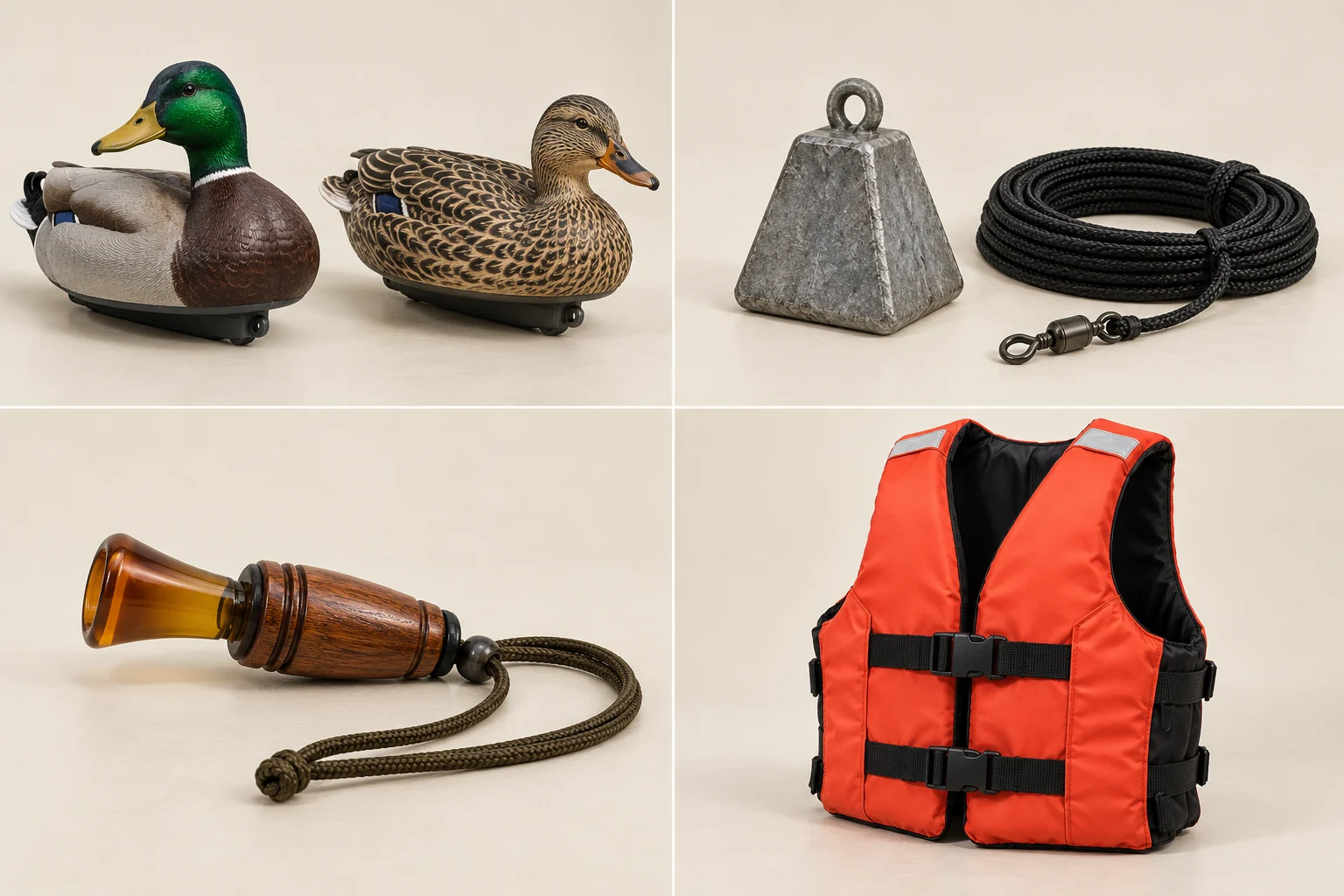
Floating Mallard decoys
A floating pair illustrates equipment intended to sit on water rather than a dry field base. Observe how the actual bodies ride and turn under current conditions. Use only positions covered by a workable recovery plan already available from the checked shore setup.
Compatible decoy anchor and coiled line
Anchoring parts keep floating equipment associated with its planned position when the design and conditions permit. Use compatible equipment and inspect attachment points before deployment. Keep coiled and loose line out of the walking area, and stop if drift makes the original recovery arrangement unreliable.
Manual duck mouth call · optional
The mouth call is an optional sound tool rather than the foundation of a bank-side setup. Give one participant control of simple, measured changes while everyone keeps their agreed position. Use a legal acoustic method; a successful example elsewhere does not authorise recorded calls here.
Personal flotation equipment
Appropriate personal flotation equipment is one part of planning around water. Select and use it according to its instructions and the actual conditions. It does not make uncertain footing, cold water or an unworkable recovery route acceptable.
SKHunter · AI-generated teaching illustration · Teaching illustration · not to scale · no distances implied
View the larger illustration ↗These are bank-side planning examples, not water-depth charts or instructions to enter the water. A flotation device, long line or dog does not make an unsuitable recovery plan workable.
Read the field layout
Symbols show relationships, not a required number of decoys. No scale, depth or shooting distance is implied.
- Floating decoys near the checked bank-side setup.
- Open water left free of spare equipment and decoys.
- A stationary hide on firm dry land, outside the bird entrance.
- A possible bird approach; the separate walking route stays on land.
- The shore line is a boundary, not a route: people and the hide remain on verified stable land.
- Water arrows show example wind and possible arrival relationships; the open pocket and all likely recovery areas must fit the actual site.
- Decoy symbols do not prescribe numbers, distances, anchors or a safe shooting direction; the diagram does not authorise water entry.
From arrival to pack-out
Confirm this exact shore is available
Keep the bags packed until access and closure checks match the actual place.
- Locate the water by name and boundary, not only the nearest town; compare current Hunters Extras and posted conditions.
- Confirm permission for the bank position, the approach and any other ground needed for recovery.
- Identify nearby people, roads, buildings, livestock and other parties before selecting the usable area.
Observe use without pushing the birds
Watch from an authorised position and describe what the wetland is being used for.
- Separate birds feeding or loafing here during the intended period from birds crossing overhead.
- Record wind, visibility, actual landing points and exits; avoid walking into a resting concentration for a closer look.
- If you cannot confirm species or an unobtrusive usable position, keep the visit as an observation rather than forcing a setup.
Choose firm footing and prove the recovery plan
Define the bank position and the entire likely fall-and-drift area before laying out decoys.
- Keep everyone on verified stable land; do not infer depth or bottom firmness from surface appearance.
- Check that suitable recovery means are immediately available and remain usable as wind or current changes.
- Agree stop triggers for drifting gear, uncertain footing, cold exposure, new ice or loss of an exit; no boat, ice or wading method is taught here.
Prepare the hide on land
Arrange people, removable cover and loose equipment without occupying the water edge.
- Match the existing background and keep the observation opening clear; do not hide so well that identification becomes difficult.
- Use only permitted vegetation or camouflage and keep bags, bright items and reflective surfaces out of the approach view.
- Give each person a known position and dry standing or sitting space; keep lines and dog equipment out of walking routes.
Recognise the tools. Understand the setup. Check the bank position before committing to the setup
Compare the dry-land observation position with the equipment positions on the water. A fixed bank position does not mean that changing wind, footing or drift can be ignored.
First: a firm bank position and checked equipment locations
Observe from the permitted dry-land position before moving equipment. Confirm footing, the land route and how each floating item can be recovered with means already available. Do not use the illustration to assume the depicted water is shallow or safe to enter.
Changed conditions: pause and reassess from land
Wind or drift can move floating equipment beyond the arrangement you checked. Pause the activity and keep people on the confirmed dry-land route. Use only the checked recovery means, and choose a verified fallback or finish if those conditions no longer hold.
SKHunter · AI-generated teaching illustration · Teaching illustration · not to scale · no distances implied
View the larger illustration ↗Place a small floating group around an open pocket
Deploy only equipment that the existing safe shore-based method can place and retrieve.
- Inspect each floater, attachment, line and anchor before use; do not substitute unsuitable field equipment.
- Arrange loose groups alongside a continuous open arrival space; follow observed bird use rather than a perfect letter shape.
- Keep lines separated and stored clear of feet; verify that anchors hold and equipment stays inside the managed area before hunting.
Set the group’s readiness and stop routine
Everyone confirms positions, identification conditions and recovery responsibilities.
- Keep firearms unloaded through setup and position changes; start only after equipment is deployed and participants are in their agreed places.
- Name a coordinator and recovery lead, but allow anyone to call a stop; each person remains responsible for their own identification and safe decision.
- Confirm the eligibility of active helpers, including decoy placement, calling and retrieval; pause for any person or dog leaving the agreed position.
Read approaches with restrained calling
Let an observer describe the response while keeping motion and communication controlled.
- Notice whether birds ignore the site, approach the pocket, turn away from the bank or choose another piece of water.
- If a manual call is used, start with one operator and avoid changing sound and decoy pattern at the same time.
- Decline uncertain species, unsuitable backgrounds or opportunities beyond the available recovery plan; do not chase them across open water.
Pause before changing the spread
Use repeated comparable observations and the actual water conditions to choose one change.
- Pause and secure the group before moving people or adjusting equipment; preserve everyone’s known position.
- Check outline, reflections, the open pocket and drift before assuming too few decoys or too little sound.
- If a safe single change cannot keep the likely recovery area manageable, reduce the setup or stop rather than stretching the plan.
Recover, cool and clear the bank
Close the outing while there is enough light and weather margin for a complete check.
- Carry out prompt recovery using the suitable available means, with the group paused and all people and any dog accounted for.
- Follow current handling and transport requirements; keep legal identification attached as required and use clean cooling storage.
- Count floaters, anchors and line assemblies, remove spent cases and litter, check gates and access conditions, and record the observation and return check-in.
If the birds do not respond
Observe → change one thing → observe again
Changed drift means a new decision
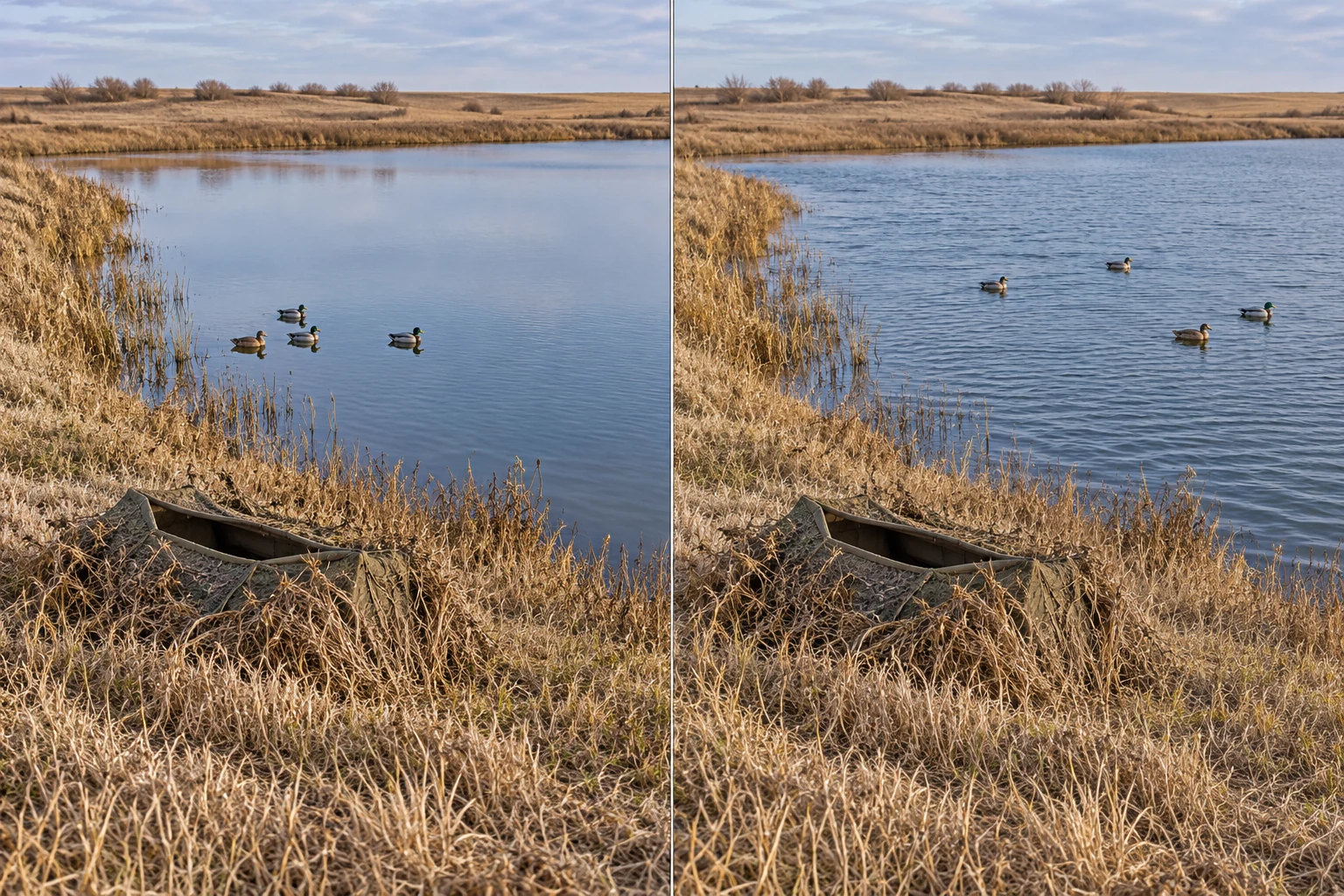
The same shore position is shown twice. A change in floating equipment position can invalidate the recovery plan even when the hide has not moved.
Before · positions match the checked plan
Note the floating positions while you are still on dry land. Use only a setup with suitable recovery means already available.
Changed drift · pause the activity
The highlighted decoys have moved farther out. Pause and use only the previously checked recovery means; if those no longer work, use a verified fallback or finish.
Orange arrows describe drifting equipment, never a route for people. Do not follow them across water.
Teaching example · not to scale. Pause and make equipment safe before anyone changes position.
| What you observe | Check first | Make one change |
|---|---|---|
| Birds repeatedly turn away near the bank. | Look from the likely approach for exposed people, reflective gear, an abrupt hide outline or blocked pocket. | Pause and correct one clear contrast or opening problem before comparing later approaches. |
| Birds settle on another part of the wetland. | Compare the actual feeding or resting use, shelter and wind with the selected patch. | Observe again or choose another already verified shore position; do not move blindly toward a roost or unapproved bank. |
| Floaters or lines creep, tangle or pull loose. | Check anchoring and whether today’s drift is exceeding equipment and recovery capability. | Pause and recover by the existing suitable method; reduce or end the setup if control cannot be maintained. |
| The water or bank changes during the wait. | Look for increasing waves, slipping footing, rising water, new ice or a deteriorating route out. | Stop and leave by the checked route while it remains usable; do not follow gear into an uncertain margin. |
| Calling or motion gets busier without a clearer response. | Separate actual bird behaviour from the group’s guess that more activity must help. | Reduce unnecessary signals, preserve one simple test and retain the option of a quiet setup or an observation-only visit. |
Open the field reference card
- Confirm this exact shore is available
- Observe use without pushing the birds
- Choose firm footing and prove the recovery plan
- Prepare the hide on land
- Place a small floating group around an open pocket
- Set the group’s readiness and stop routine
- Read approaches with restrained calling
- Pause before changing the spread
- Recover, cool and clear the bank
Before the next outing
Leave with a record of the bank position, actual water movement, the response to one change and the point at which the recovery plan would no longer work.
Worked example: the breeze begins carrying the setup away
Two eligible participants have permission for a small wetland edge, have checked the current closure list and are using a bank position with a tested recovery method. As the breeze strengthens, an outer floater starts creeping away from the original managed area.
Put it into practice
- Call a group pause and secure the hunting equipment; nobody follows the decoy into the water.
- Compare its movement with the recovery method, the bank condition and the likely fall-and-drift area.
- Recover the affected equipment only by the already suitable shore-based method. Reduce the setup or end the hunt if adequate recovery cannot be maintained.
- Record the wind and the stop decision. Reassess all positions and permissions before any later restart.
Turn a sighting into a useful note
A 36-second photographic motion explainer with gentle camera movement, four clear chapters and large on-screen words. Silent; optional captions and a transcript are available.
Choose a section or use the player controls. A text transcript is available below.
Read the video transcript
- 0:00
Describe what you actually saw — Record shape, markings and behaviour before assigning a species name.
- 0:09
Record the observation context — Add the date, viewpoint, light and approximate distance.
- 0:18
Keep uncertainty visible — A single track or a brief glimpse may remain unidentified.
- 0:27
Revisit without assuming — One sighting is not a population estimate or a promise for next time.
Common mistakes to avoid
Treating a shallow-looking margin as walkable
Mud, drop-offs and floating vegetation may be hidden. This lesson keeps people on verified stable land; uncertain footing is a site-selection problem, not something to test by stepping farther.
Planning to work out recovery after a bird falls
Agree the recovery lead and suitable available means before hunting, including likely drift and property boundaries. Decline opportunities that exceed that plan.
Copying a pretty spread across the whole pond
A dense ring can remove arrival space and push equipment beyond controllable water. Keep only the area that remains usable, observed and recoverable.
An outer decoy drifts toward water your available recovery method cannot cover. What should the party do?
- Send the nearest person after it because the margin looks shallow.
- Pause, stay on verified land and reassess; safely recover what the existing method can cover, then reduce or stop the hunt.
- Add more decoys to hold birds closer while leaving the drifting one.
Show the answer and explanation
Answer: B. Pause, stay on verified land and reassess; safely recover what the existing method can cover, then reduce or stop the hunt.
The managed area is defined by actual access, conditions and prompt recovery capability. When those no longer match, a coordinated pause and a smaller plan or cancellation is the useful response.
Ducks: a count can be known while identity remains uncertain
This fictional recording exercise works for a dry-field viewpoint or a checked dry-bank viewpoint. It does not propose a route across water or hidden ground.
Fictional teaching example, not a parcel sighting or current conditions report. Example times are not hunting-hour guidance.
Scroll across the table to compare each observation with its interpretation and next check.
| Time | Direct observation | Count and scope | Interpretation / uncertainty | Next check |
|---|---|---|---|---|
| One bird is visible, but the view does not resolve useful identification features. | 1Observed count One bird; species unconfirmed. | The number one is supported. A species name is not supported by that view. | Keep identity uncertain and try to retain the same individual in view. | |
| The same individual remains continuously in view; head, bill and body can now be described. | 1Observed count One bird in a continuous follow-up view. | This is a better identification view, not a second unique bird. The recorded features still need comparison with a reference. | Describe the visible features, then use the identification lesson without switching to another bird. | |
| The next sector is hidden by vegetation or a ground fold and is not inspected. | Unknown Unobserved sector; no count available. | An uninspected sector does not become a zero because no bird was reported from it. | Use a checked viewpoint or keep the sector marked unknown. |
Counts belong to the stated view or sample. Repeated views may include the same animals; these rows are not summed into a unique population total.
A concrete next action
Record the number and identification confidence separately. Keep the dry-field or bank context in the note so a later visit can repeat the same view.
Pause and reflect
How many unique birds are demonstrated by the first two rows?
Read the reasoning
One individual is continuously followed in this fictional example. The second row improves the view; it is not an additional bird. The third row supplies no count.
Terms on this page
Open a term for its meaning, a common mix-up and the existing guide. English terms and acronyms are retained.
retrieval / recovery
The separate plan for finding and bringing back a bird or animal described by an outing.
Common mix-up: A return plan for people does not describe every animal-retrieval task; keep recovery limits visible.
sample coverage
The view or ground, and observation interval, that were actually checked for a particular record.
Common mix-up: Hidden or uninspected ground lies outside that checked sample, even when it is nearby.
unknown count
A record for which no reliable numerical animal count was obtained.
Common mix-up: Unknown is not zero. Uncertain species identity does not by itself erase a number actually seen.
Current checks and official context
Scope, place and participants
This course covers observation and hunting from a checked dry bank. It does not teach boating, wading, ice access or improvised water recovery. A map, picture or permission for the bank does not establish access to every water area or a workable recovery plan. Context checked November 1, 2026 for 2026–27.
Carry the applicable Saskatchewan game bird licence, Wildlife Habitat Certificate and federal MGBH Permit with its stamp. Active decoy placement, calling and retrieval helpers also need the applicable eligibility and permits.
Identify the species and check this location
Identify the actual species, then use the current All ducks, combined row for combined daily and possession limits, together with the applicable district, dates and conditions. Use and possess only non-toxic shot during the hunt. These lessons use manual mouth calls; white-goose provisions do not authorise recorded duck calls.
Check the current Hunters Extras named-water lists. They include year-round closures and seasonal game-bird restrictions extending in, on or within 500 metres of listed waters. A dry-bank or field position can fall inside a closure; do not apply this distance as a universal rule for every pond.
Normal harvest residue differs from bait. Do not scatter food or imitation feed to improve a setup; clarify suspected baiting and its restrictions before hunting.
Recovery, handling and departure
A reachable decoy does not establish that every bird fall is recoverable. Check likely falls, drift, permissions and the actual means before starting; stop if they cease to be workable. Select and wear appropriate flotation protection for the exposure, without treating it as permission to enter water or bypass bank assessment.
Have suitable recovery means immediately available for reasonably expected bird falls, including beyond the decoys, and arrange all necessary access. Pause the group before people or dogs move; do not use motor vehicles to pursue or hunt birds.
Retrieve promptly, wear gloves for handling, clean hands and equipment and cool birds. For unpreserved birds keep the required fully feathered head or wing attached for identification; check tags before transfer or transport by someone else. Follow the linked current handling advice.
Pocket lesson card
Public teaching summary for review and offline reading. It contains no actual trip records, permissions, parcel conditions or coordinates. Use the full lesson and current official guidance for your own plan.
Save the HTML for offline text. Use your browser’s Print menu to print the opened card; online links require a connection.
Read the pocket card
Ducks · shore preparation
Before leaving
- Choose a verified firm-bank position with recovery already planned.
- Inspect floating-decoy lines and anchors before placing the set.
At the location
- Compare wind and drift with the planned exit and recovery arrangement.
- Keep uninspected water or ground explicitly unobserved.
Return
- Close the return check-in and collect equipment and waste.
- Use the checked recovery arrangement; stop if it no longer works.
Review
- Choose one missing piece of evidence to check next time.
- Retain the bank context and hidden sectors with the observation.
A fictional observation example
Fictional example: one bird is seen in the checked sector. The adjacent screened sector is uninspected: record one for the view and unknown for the hidden sector.
Full reviewed lesson · onlineSource lesson editorial review: 2026-11-01
Turn this lesson into your next outing
Review the date, species, starting template and linked day plan in an editable preparation draft. You choose what to add and save.
Prepare your own trip
Review a preparation draftContinue learning
Ducks in harvested fields: read the feeding patch and build a workable setupTry a practical situation
Recovery reaches beyond the agreementOpening a draft does not create a saved checklist. A checked item records your own review, not permission or an open season.
Scenario practice
Put your field decisions into practice.
Try 24 situations across identification, access, field adjustments and harvest care. Compare your choice with the explanation, then revisit the relevant lesson.
Original sources
- Government of Saskatchewan · Waterfowl licences and habitat certificate
- Environment and Climate Change Canada · Saskatchewan migratory-bird summary
- Environment and Climate Change Canada · Migratory game bird hunting FAQ
- Government of Canada · Migratory Birds Regulations, 2022
- Government of Saskatchewan · Avian influenza and handling wild birds
- Government of Saskatchewan · Hunters Extras, game-bird water closures
- Transport Canada · Choosing lifejackets and personal flotation devices
- Ducks Unlimited · Strategies for Small-Water Ducks
- Ducks Unlimited · Think Small for Ducks
- Ducks Unlimited · Decoy Basics
- Ducks Unlimited · Duck Scouting 101
- Missouri Department of Conservation · Waterfowl Safety and Health
Use this as a planning guide. Check current official requirements and site conditions before travelling.
Help improve this guide
Tell the editor about something on this public page that needs attention.