
Guest reading progress stays in this browser and is not synchronized to your account automatically. Use the learning panel to include browser marks and save them explicitly. Clearing site data removes browser marks.
Your learning notebook
Save courses and review situations deliberately. Load your account records on another device when you want to continue.
Bookmarks and review choices stay in this browser until you load and save an account. Answers and time spent reading are not recorded.
Saved courses
Saved situations to revisit
Find your marked situations by title or topic, then open the original question and explanation.
Your review choices will appear here when this learning view is ready. Use the account controls above to load account choices.
No situations are marked for review in this learning view.
No saved situation matches these filters. Clear the search or choose all topics.
Identification practice
Land access practice
Field decisions practice
Harvest care practice
Turn an old scouting note into a sensible revisit plan ↓
Rewrite a field note that claims too much ↓
Beginner field workshop
Turn an old scouting note into a sensible revisit plan
An old note is evidence about an earlier visit, not a current trip approval. Use the fictional record below to decide what remains useful, what was never established and what you must check before returning.
Fictional record: on 2026-09-12, 16:10–16:20, an observer at A saw six large birds land in the visible corner B. Species was not confirmed; the far side was hidden. The old permission note covered only that day’s observation walk. No actual location or current permission is supplied.
The table scrolls independently. Focus it and use the arrow keys to see every column.
| Vague claim | Record the evidence actually supplied | Next check before a revisit |
|---|---|---|
| “They use it.” | Six large birds landed in visible B during 2026-09-12, 16:10–16:20. | A new visit needs a new observation interval; do not copy the old count into today. |
| “Geese.” | Large birds; the supplied view did not confirm species. | Seek suitable identification evidence without promoting the old label into a fact. |
| “Good whole field.” | Only corner B was visible from A; the far side was not inspected. | Choose a lawful observation position and state its actual visible scope. |
| “Access fine.” | The earlier access note covered that day’s observation walk only. | Confirm the people, date, activity, parking and approach for the new outing. |
| “The saved point is the entrance.” | No checked entrance coordinate was supplied in this example. | Treat the point as a reference until the actual approach and parking have been checked. |
Practise the conversation and the change
Can the earlier count become today’s “six birds present” note?
Keep the count with its original date, interval and view. If you have not revisited, today’s count is unknown; a useful old observation does not become a current observation through copying.
A new visit can add a second record with its own conditions. Compare the visits afterwards rather than replacing one with the other.
Which next action makes this candidate easier to use?
Choose a question you can resolve: for example, confirm whether the proposed observation-only return and approach are acceptable for the new date. Give that task an owner and a way to obtain an answer.
Keep identification and hidden-ground questions separate. Finishing the access task does not complete every other field in the trip plan.
Check actual requirements with the official sources
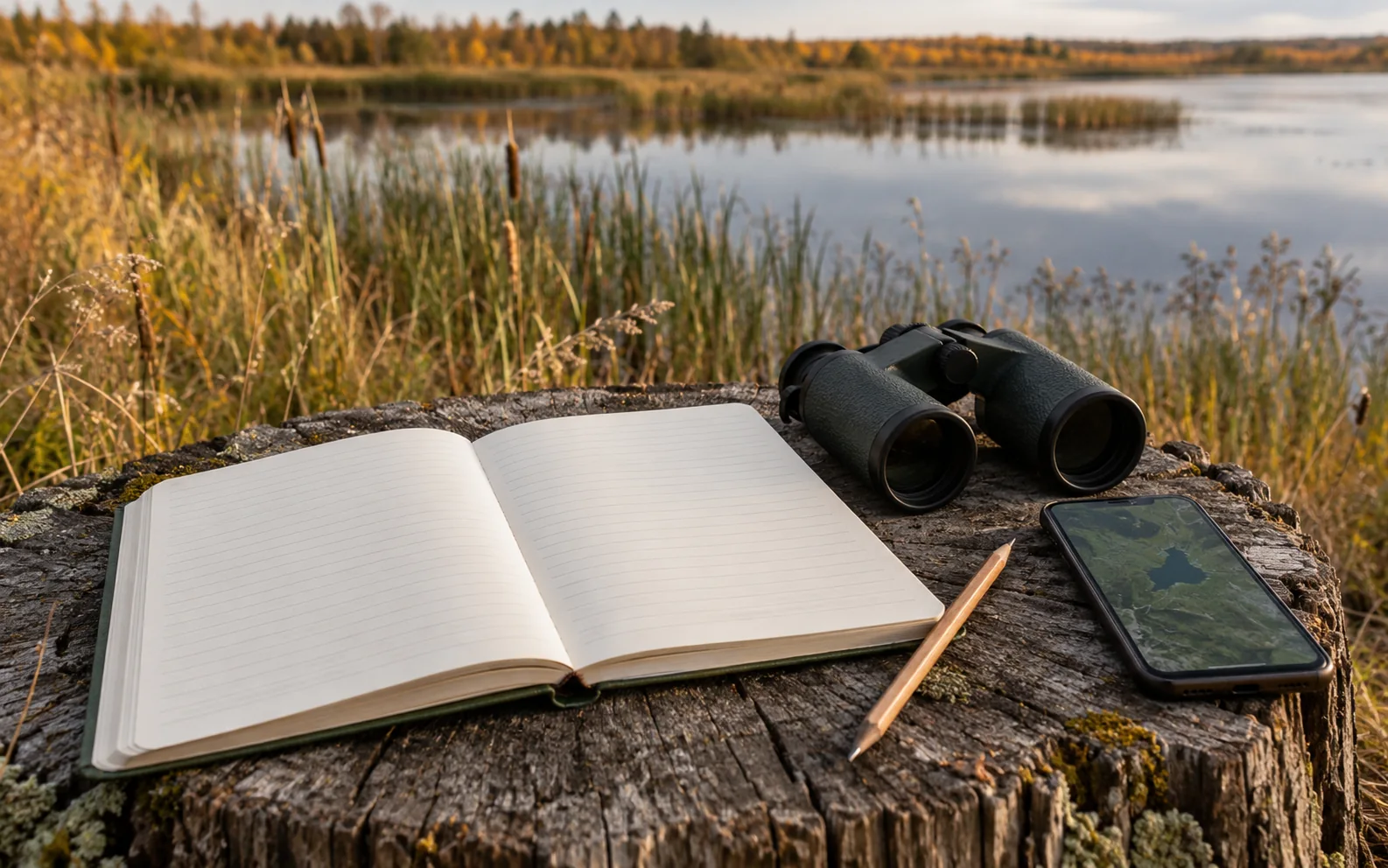
Original AI-generated photo-style teaching scene for SKHunter; depicted people, documents and maps are illustrative.
Image credit: SKHunter · original AI-generated photo-style imageWhat you will learn
- Give different kinds of evidence their own records.
- Write observations that remain useful months later.
- Maintain a shortlist without turning old notes into current facts.
An original SKHunter learning guide
Build a record, not a prediction
Teaching diagram · not a map- 01Observe
Look from a lawful position without moving closer to obtain an answer.
- 02Describe
Record visible features, time, light, distance and behaviour.
- 03Keep uncertainty
Separate what you saw from what you think it might mean.
One clue starts a question. Several consistent observations build a better record; uncertainty remains a valid outcome.
Use three records for three different questions
The parcel record answers where the land is and what the source says. The access record answers who gave what information, for which people, date and conditions. The observation record answers what you saw during one visit. Keep those questions separate even when all three records refer to the same place.
For example, a green field on a satellite image is a map observation, a neighbour’s phone number is a contact lead, and a dated sighting is field evidence. None automatically answers the other questions. Link records by a clear legal description or parcel identifier so similar nearby names do not cause a mix-up.
Write a note your future self can understand
Use a consistent sequence: when, where, observation position, conditions, direct observation and uncertainty. “Good place” will mean little in six months. “From the checked roadside position, I could see only the near half of the wetland; no birds seen during this visit” explains both the finding and its limits.
Add practical details that are easy to forget, such as which map source you used or why an entrance was marked unconfirmed. Keep interpretations in a separate sentence: “possible track, not checked.” Respect other people’s privacy when storing contact messages or photographs and avoid including them in public shares.
Review the shortlist rather than only adding to it
Give every saved candidate a next action and a reason to keep it. One might need a boundary check, another a lawful approach, another a return observation in different conditions. This makes your favourites an actionable queue rather than a growing collection of places you no longer remember.
Before the next outing, revisit the age and status of the relevant records. A removed day plan or changed entrance should be resolved deliberately. Export private backups when appropriate and check that they contain the records you expect; a public map link is useful for location sharing but is not a backup of your private notes.
Worked example: an old favourite has no clear reason
You saved a parcel months ago with the note “looks good.” There is no observation date, entrance check or current access arrangement attached to it.
Put it into practice
- Keep the parcel as a candidate rather than treating it as ready for a visit.
- Identify which facts came from the map and which, if any, came from a field visit.
- Add a concrete next action such as confirming the approach or identifying an authorised contact.
- Complete fresh outing checks before using it in a day plan.
Turn a sighting into a useful note
A 36-second photographic motion explainer with gentle camera movement, four clear chapters and large on-screen words. Silent; optional captions and a transcript are available.
Choose a section or use the player controls. A text transcript is available below.
Read the video transcript
- 0:00
Describe what you actually saw — Record shape, markings and behaviour before assigning a species name.
- 0:09
Record the observation context — Add the date, viewpoint, light and approximate distance.
- 0:18
Keep uncertainty visible — A single track or a brief glimpse may remain unidentified.
- 0:27
Revisit without assuming — One sighting is not a population estimate or a promise for next time.
Common mistakes to avoid
Writing conclusions without observations
Record the visible evidence and its limits before your interpretation.
Treating an old favourite as current permission
Check the dated access record and actual conditions again.
Using a public link as a private-data backup
Use the private export and verify its contents.
Where should “a neighbour gave me this phone number” go?
- A confirmed permission record.
- A wildlife population estimate.
- A contact lead with its source and remaining questions.
Show the answer and explanation
Answer: C. A contact lead with its source and remaining questions.
The information helps identify a possible contact. It does not establish authority, permission or anything about animal presence.
Rewrite a field note that claims too much
Use the supplied fictional evidence to write a record another reader can check. Separate the inspected view, counts, location evidence and unresolved questions.
Original fictional exercise: places, observations and times below are invented. Use only these materials, not your actual sightings or private notes.
The evidence you are given
- 09:10–09:15: from observation station A, the visible sector beside landmark B was checked. No animals were seen in that view.
- 09:18: a track was photographed near landmark B. No animal was seen with it; its species and age were not established.
- The screened sector C was not inspected.
- The saved phone fix belongs to observer station A. No separately checked track or animal-position measurement was supplied.
“Mule Deer were here last night. The whole place has no deer now. The GPS pin proves where the track was.”
Compare with one possible rewrite
This is one clear version, not a required wording or a scored answer. It uses only the fictional evidence; it does not create a real observation record.
- Observed facts, time and scope
- From station A, the visible sector beside B was checked during 09:10–09:15; no animals were seen. At 09:18 a track was photographed near B. Sector C was not inspected.
- Counts and unknowns
- Animal count for the checked view during 09:10–09:15: zero. Count for uninspected C: unknown. The track supplies no animal count; species and sign age are unconfirmed.
- Location evidence
- The saved phone fix is observer station A. “Near landmark B” describes the track, not a separately measured track coordinate. No animal position was established.
- Unresolved questions and one next check
- Track species and age remain unresolved. Next question: can a checked observation position cover sector C? If it is inspected later, record the visible scope and interval instead of filling the gap now.
Terms on this page
Open a term for its meaning, a common mix-up and the existing guide. English terms and acronyms are retained.
observer fix
The recorded position of the observer’s device when its location was saved.
Common mix-up: It locates the observer, not automatically the animal seen across the field.
estimated animal position
An approximate animal location inferred from the view, direction and landmarks, kept separately from the observer fix.
Common mix-up: Moving a phone fix does not preserve its measured status or turn the animal estimate into a measurement.
direct observation
What was actually seen, heard or measured, with the view and context recorded.
Common mix-up: A sound can be observed without confirming an animal’s identity or number.
inference
An explanation or estimate drawn from observations, rather than another separately observed fact.
Common mix-up: A confident file name, habitat label or repeated copy does not add a new observation.
Current checks and official context
Build a shortlist with a reason for each parcel
Search the land directory using a legal land description, RM or name, then narrow by available distance and area information. Save a short reason for each candidate: location, past observation or a feature you want to inspect. Check whether the record has a matched boundary or only a reference location.
- Compare the original source and access evidence.
- Keep partial SWF reference coverage in mind.
- Use the map to inspect the shortlist geographically.
Separate entrances, contacts and observations
A parcel reference position is not an entrance. Save parking or access points separately and record their check status. Use Land contacts for information you obtained yourself, including the exact permission period and conditions. Put bird sightings, habitat observations and unsuccessful visits in the field notebook.
- Attach each record to the correct land description.
- Record what you saw, when you saw it and what remains uncertain.
- Recheck an older observation before using it for a new outing.
Keep your records usable and private
Signed-in records can sync through your account; guest records remain in the current browser. Review the sync status before switching devices and keep a private backup of important notes. Do not publish a landowner’s contact details or precise private access points without their agreement. The public map and your personal records serve different purposes.
Turn this lesson into your next outing
Review the date, species, starting template and linked day plan in an editable preparation draft. You choose what to add and save.
Prepare your own trip
Review a preparation draftContinue learning
Ask for land access and keep a useful permission recordTry a practical situation
What does your GPS pin locate?Opening a draft does not create a saved checklist. A checked item records your own review, not permission or an open season.
Scenario practice
Put your field decisions into practice.
Try 24 situations across identification, access, field adjustments and harvest care. Compare your choice with the explanation, then revisit the relevant lesson.
Original sources
Use this as a planning guide. Check current official requirements and site conditions before travelling.
Help improve this guide
Tell the editor about something on this public page that needs attention.