
Guest reading progress stays in this browser and is not synchronized to your account automatically. Use the learning panel to include browser marks and save them explicitly. Clearing site data removes browser marks.
Your learning notebook
Save courses and review situations deliberately. Load your account records on another device when you want to continue.
Bookmarks and review choices stay in this browser until you load and save an account. Answers and time spent reading are not recorded.
Saved courses
Saved situations to revisit
Find your marked situations by title or topic, then open the original question and explanation.
Your review choices will appear here when this learning view is ready. Use the account controls above to load account choices.
No situations are marked for review in this learning view.
No saved situation matches these filters. Clear the search or choose all topics.
Identification practice
Land access practice
Field decisions practice
Harvest care practice
Useful reading before this lesson
Start with these guides for background and preparation. You can open any guide at any time.
Brief the outing · Elk
A planned observation of clearings and cover, with group visibility and the capacity for a full return recorded separately.
An original planning summary to use with the full lesson. Check current law, permission, identification and local conditions separately; this card does not establish readiness or eligibility.
Open the briefing and field checks
Three tools and their jobs
- Binoculars: distinguish visible individuals from obscured parts of a group.
- Timed observation log: record duration as well as sightings.
- Team transport worksheet: identify people, loading route and receiving arrangements before a later hunt.
Rehearse the complete visit
- Before leaving: Choose one verified observation point and a defined observation period; keep the return fixed in the plan.
- On arrival: Describe the visible clearing and the portions of surrounding cover hidden from view.
- Brief and organise: Log seen animals without inventing a total for the hidden group; note any change in conditions during the observation.
- Return and review: Return as agreed and compare observations across visits before planning a more demanding outing.
Two avoidable mistakes
- A partial group view cannot provide an exact group total.
- Interesting habitat does not replace the people and transport needed for recovery.
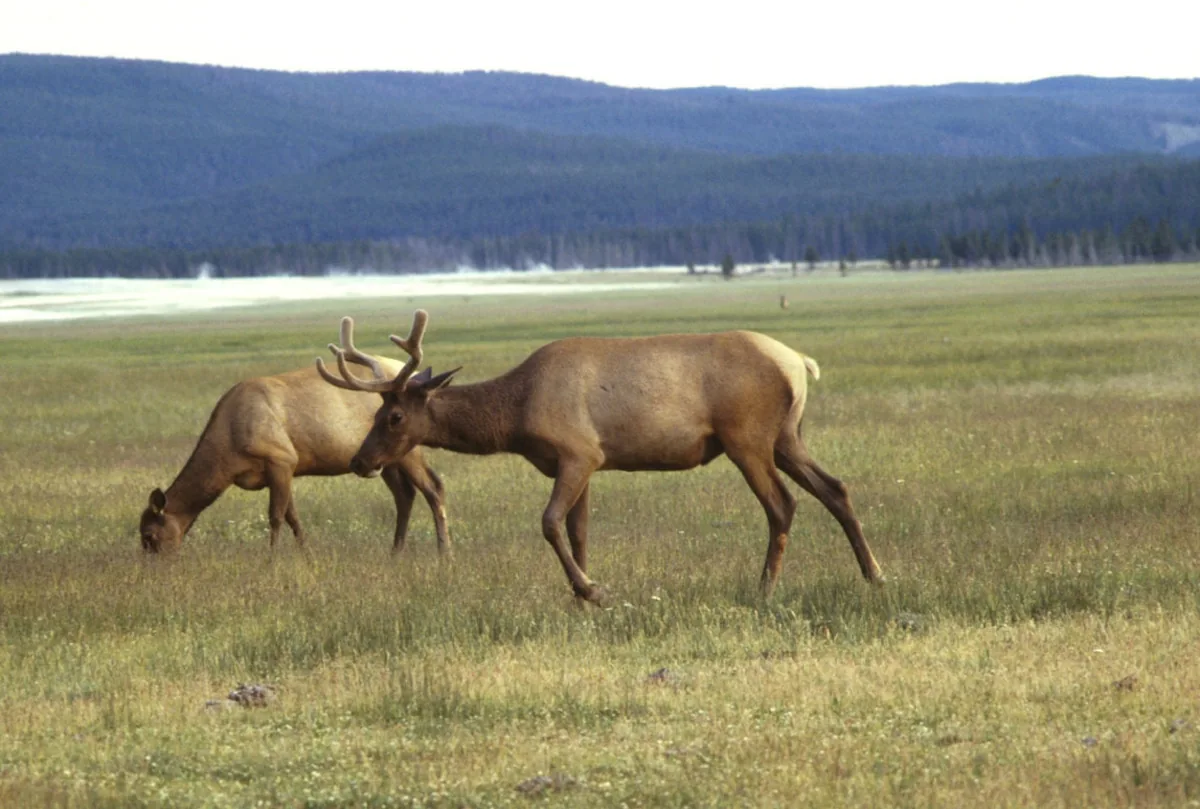
Real species reference photograph from the credited source. This is one view of an individual, not a local sighting or evidence of current animal numbers. Use the lesson to connect observations with a checked field plan.
Image credit: Jim Leupold · via USFWS · Public Domain · View image sourceWhat you will learn
- Read the relationship between feeding openings and nearby cover.
- Keep group counts, sound and sign as different kinds of evidence.
- Plan communication, access and retrieval before expanding the circuit.
An original SKHunter learning guide
Compare connected cover and openings without inventing a herd route
A useful Elk plan records the view and the time spent watching, then leaves room for a different explanation.
Conceptual sketch · no scale, coordinates, parcel boundaries or suggested destination. The walking route is assumed checked for this example; every real approach needs its own access and ground checks.
Read the sketch
- A · checked observation point
- R · return / meeting point
- Dashed green line · checked walking route
- Hatched area · not checked; outside this plan
Habitat shapes: Dark green patches: cover. Pale central shape: an opening. The diagram shows relationships, not population or movement data.
What is actually observed
From A, part of the opening is visible; the edges behind cover are not.
What still needs evidence
The patches may connect resources, but this sketch does not establish a herd, feeding schedule or a route through cover.
Work through the example
- 01
Keep one observation position
Choose A on checked ground and keep the agreed return at R. Avoid changing the plan to follow an unverified lead.
- 02
Describe the opening
Record the visible meadow and the cover that prevents a complete view. Add the time and duration.
- 03
Test an interpretation
A neighbouring forest patch and opening may suggest a question about use; one quiet visit does not answer it.
- 04
Close the visit on time
Return along the checked route and use the debrief to choose the next observation, not to erase uncertainty.
Rehearse your own decision
Describe the evidence first, then decide what needs checking before another visit.
- Have you kept a broad habitat interpretation separate from an actual Elk sighting?
- If some animals were hidden, could your group count explain that limit?
- Does the route and team still support the planned return and any lawful retrieval?
Build an opening-and-cover notebook page
Elk eat a range of vegetation, including grasses and other plants; this does not make every opening an occupied feeding site. Choose a small checked area with an opening and nearby cover you can observe without pushing through it. Sketch what each station can see and the ground between stations. Note whether a clearing is a map feature or something you have inspected this season. Give the visit a concrete purpose: describe use of this opening during this observation period, not locate a promised herd.
- Label stations and blind areas before linking them into a circuit.
- Keep seasonal observations separate from a current official hunting check.
Count a group transparently
Begin with the animals clearly visible, then divide the view using landmarks. Track where an individual enters cover before adding another appearing animal to the total. When overlap prevents a reliable count, write a minimum visible number and describe the uncertainty. Record only sex or age categories you can actually support from the view; do not classify every hidden animal from the one obvious individual. Keep your station and approximate animal positions separate so later visits do not turn the observer pin into a false herd location.
Use sound as a prompt to observe, not a destination
Pause and listen from a checked location, but keep what you heard separate from what you saw. Wind, terrain and vegetation can change sound, and another person may be calling. A bugle-like sound does not establish a safe direction of travel, an exact distance or an individual’s identity. Do not move toward an unseen caller or add calling simply to force a response. Mark the general observation and return to a permitted point where you can assess the scene without putting people or animals under pressure.
Read sign in context rather than assigning a herd
A track, pellet group or disturbed vegetation can help form a question about use of a place. Photograph it with surface context and a scale, noting the observation time and weather you know. Do not estimate a precise herd size from a busy patch or call one sign a fresh bull location. Revisit from a checked route when useful, and compare direct sightings with the sign record. Keep the description honest when another ungulate, overlapping visits or unknown weather could explain what remains.
Keep a circuit together with communication points
Choose short legs with named regroup points and a shared return, rather than scattering people around several openings. Explain who is with whom, what happens if communication fails and which leg ends the day. Check each parcel and crossing involved in the circuit; seeing animals move through a boundary does not extend your arrangement. If someone loses the group, visibility drops or the planned point cannot be identified, stop the next leg. A smaller circuit everyone understands is more useful than several disconnected sightings.
Budget for the additional work before going farther
For a hunting outing, plan the lawful retrieval route, people, equipment, cooling destination and current species-specific CWD questions before choosing a distant opening. Test the approach with an ordinary practice load and discuss the parts that would become difficult with repeated trips. A vehicle marker says where a vehicle was, not whether it may or can reach the animal. Use a preselected turnaround decision when daylight, footing or team capacity changes. Finish by recording the circuit actually used and one improvement for the next visit.
- Keep trained help and current handling arrangements in the plan.
- Resolve recovery and access gaps before committing to a farther destination.
Case: one sound, several openings
The group hears a bugle-like sound beyond cover. One companion wants to take a shortcut while others continue along the original circuit.
Put it into practice
- Stay at the named regroup point and distinguish the sound from a sighting.
- Do not assign an exact distance or identify an unseen caller.
- Review the checked circuit and agree on one shared next decision.
- Use the planned observation point or finish by the confirmed return.
- Record the sound, conditions and unresolved question separately from any later visible animals.
Common mistakes to avoid
Every appearance is a new animal
Use landmarks and minimum visible counts when animals move in and out of cover.
Sound supplies a safe approach
An unseen sound does not reveal people, footing, access or identity.
Recovery starts after the event
Choose the route and available help before extending the outing.
An elk-like call is heard behind cover. Which note is best supported?
- One bull is exactly a known distance away.
- Unseen call, general direction noted; caller and distance unconfirmed.
- All nearby openings contain elk.
Show the answer and explanation
Answer: B. Unseen call, general direction noted; caller and distance unconfirmed.
Record the sound as sound. Visibility, identity, access and distance remain separate questions.
Elk and Moose: keep provisional labels separate
Two fictional notes use different provisional names. This exercise keeps Elk and Moose as separate identification questions; neither name substitutes for evidence.
Fictional teaching example, not a parcel sighting or current conditions report. Example times are not hunting-hour guidance.
Scroll across the table to compare each observation with its interpretation and next check.
| Time | Direct observation | Count and scope | Interpretation / uncertainty | Next check |
|---|---|---|---|---|
| One animal is visible at the first landmark; the note is provisionally labelled Elk. | 1Observed count One visible animal; Elk label unconfirmed. | The count concerns the view. The provisional label is a question, not a verified Elk identification. | Keep the descriptive note and resolve the identification using the linked Elk lesson. | |
| One animal is visible later at another landmark; the note is provisionally labelled Moose. | 1Observed count One visible animal; Moose label unconfirmed. | A second provisional name does not validate either name or prove a different individual. Do not combine the records into an Elk or Moose total. | Compare each note with its own reference and retain uncertainty about both species and repeats. | |
| A sound is recorded behind cover without a visible animal. | Unknown Unidentified sound; animal count unknown. | The sound does not establish a species or a numerical count. It is not another confirmed animal. | Keep a separate sound note without assigning Elk, Moose or zero animals. |
Counts belong to the stated view or sample. Repeated views may include the same animals; these rows are not summed into a unique population total.
A concrete next action
Review identification, repeat status and route separately. A useful next action can be another checked observation or ending the visit with uncertainty recorded.
Pause and reflect
What is wrong with reporting “two Elk/Moose plus one heard”?
Read the reasoning
It merges distinct unconfirmed species labels, assumes the two views contain different individuals and turns a sound into an animal count. Keep the three evidence records separate.
Terms on this page
Open a term for its meaning, a common mix-up and the existing guide. English terms and acronyms are retained.
inference
An explanation or estimate drawn from observations, rather than another separately observed fact.
Common mix-up: A confident file name, habitat label or repeated copy does not add a new observation.
unknown count
A record for which no reliable numerical animal count was obtained.
Common mix-up: Unknown is not zero. Uncertain species identity does not by itself erase a number actually seen.
sample coverage
The view or ground, and observation interval, that were actually checked for a particular record.
Common mix-up: Hidden or uninspected ground lies outside that checked sample, even when it is nearby.
Current checks and official context
Match the current Saskatchewan opportunity
Before a hunting outing, match the actual species, person, licence, WMZ, method and date with current official tables and later updates. The landscape examples do not determine eligibility or an open season.
Keep biology, access and health checks distinct
Out-of-province wildlife references explain biology, not Saskatchewan hunting law. Confirm the whole route and land conditions separately, then review current CWD and handling arrangements for the actual outing.
Pocket lesson card
Public teaching summary for review and offline reading. It contains no actual trip records, permissions, parcel conditions or coordinates. Use the full lesson and current official guidance for your own plan.
Save the HTML for offline text. Use your browser’s Print menu to print the opened card; online links require a connection.
Read the pocket card
Elk · field preparation
Before leaving
- Choose a specific observation question instead of following an old report.
- Confirm retrieval people, equipment and access before extending the plan.
At the location
- Mark the current view and the ground hidden from the checked station.
- Keep a species label provisional when the view does not support it.
Return
- Close the return check-in and collect equipment and waste.
- Keep observation and sign records tied to their own locations.
Review
- Choose one missing piece of evidence to check next time.
- Do not combine provisional Elk and Moose notes into a species total.
A fictional observation example
Fictional example: one visible animal is provisionally labelled Elk. Keep the count of one separate from the unconfirmed identification.
Full reviewed lesson · onlineSource lesson editorial review: 2026-11-02
Turn this lesson into your next outing
Review the date, species, starting template and linked day plan in an editable preparation draft. You choose what to add and save.
Prepare your own trip
Review a preparation draftContinue learning
Big game after the harvest: plan cooling, transport and a traceable handoverTry a practical situation
A large animal at the timber edgeOpening a draft does not create a saved checklist. A checked item records your own review, not permission or an open season.
Scenario practice
Put your field decisions into practice.
Try 24 situations across identification, access, field adjustments and harvest care. Compare your choice with the explanation, then revisit the relevant lesson.
Original sources
- National Park Service · Elk biology
- Wisconsin DNR · Elk observation and avoiding disturbance
- Government of Saskatchewan · Current Hunters Guide and updates
- Government of Saskatchewan · Current hunting opportunities and species context
- Government of Saskatchewan · Current CWD testing and sample arrangements
Use this as a planning guide. Check current official requirements and site conditions before travelling.
Help improve this guide
Tell the editor about something on this public page that needs attention.