ALBERTA / BEGINNER FIELD GUIDE
Alberta hunting hours: sunrise, sunset and a workable return
Learn how to check the daily time restriction, use the correct location and ABT clock, and leave room for a shorter field day. Includes a fictional worked example and a practice quiz.
14 min read · Checked
2026 Alberta Hunting Guide; 2026–27 federal migratory-bird summary; permanent ABT transition from November 2026
What you will be able to do
Build a dated time card that separates the applicable hunting-hours boundary from daylight observations, site access and your own earlier stopping and return decisions. Explain any clock conversion instead of silently adjusting an app.
Separate the rule layers
- Alberta / provincial
- The current Alberta Guide’s general prohibition places hunting wildlife and firearm discharge outside the interval from half an hour before sunrise to half an hour after sunset. Check the actual rule, species, licence, date and place; this lesson does not assess exceptions or individual legal eligibility.
- Canada / federal
- Migratory birds also have federal hunting-hour requirements. Read the current Alberta ECCC summary and the Migratory Birds Regulations, 2022, alongside provincial and local requirements. A federal permit does not remove another applicable restriction.
- Field practice / planning suggestion
- Earlier stopping, return margins and the time-card exercise below are planning suggestions, not extra legal minutes or a visibility guarantee. All example clock values are fictional, not published times for a real place or date.
Pack and prepare
- A time card with date, actual location reference, species, licence period, source links and source time-zone labels.
- A checked watch or phone clock, with the UTC offset recorded; do not rely on a device that has an unresolved time-zone update.
- Offline route information and a paper backup that you can read, with separately checked lawful access and a shorter alternative.
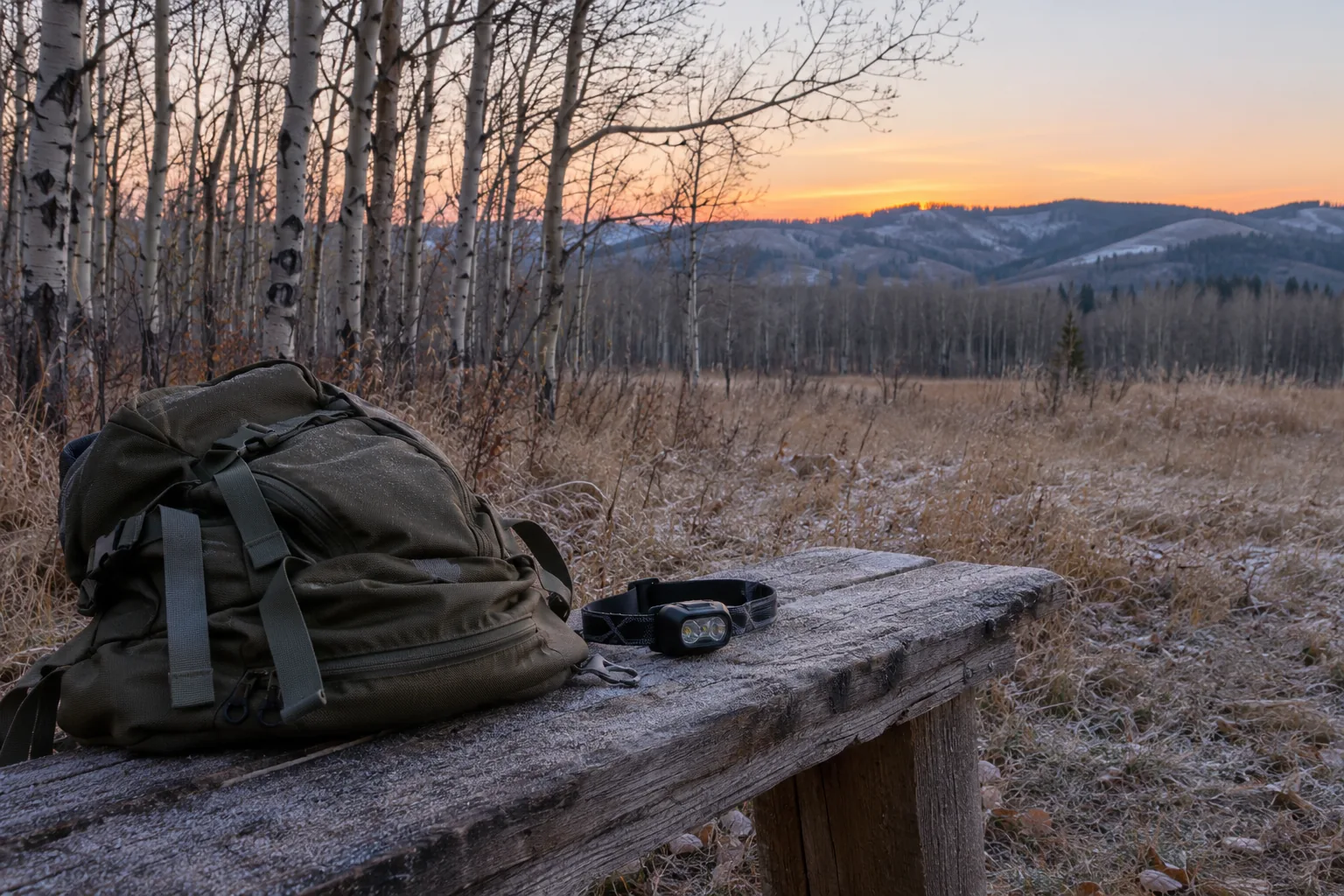
- A tested headlamp, backup power and weather-appropriate supplies for lawful travel and an unplanned delay.
- A private return/check-in plan shared with a trusted person; test equipment without sending an emergency activation.
Adapt this starter list to the actual site, season, group and activity. It is not a complete equipment standard.
Work through the outing
STEP 01
1. Check three separate questions before reading the clock
Start with your actual species and animal class, licence and date, then the place where the activity would occur. A season result answers a calendar question; it does not calculate today’s lawful daily hours or establish permission to enter. Write three headings: season and personal licence, daily hours, and site access. Under each, record what you checked and what remains unresolved. A reference point in a large PLUZ is not your actual hunting position, and a park outline can contain independent conditions. Keep a closed site or uncertain licence unresolved rather than treating an attractive sunrise as a reason to proceed. Ask the responsible authority when a rule’s scope is unclear.
STEP 02
2. Match the date, location and actual clock convention
Open the current Alberta sunrise/sunset guidance, then the linked NRC calculator if you need a more specific reference. Record the selected date and location before copying any number. Read the result’s time convention: a Standard Time table and an already-localized forecast are not interchangeable. Alberta adopted permanent Alberta Time, ABT, UTC−06:00, from November 1, 2026. Older winter MST assumptions and generic seasonal clock-change instructions can therefore mislead. Check the actual offset used by the source and your device, reconcile them once, and label the converted result. Do not automatically add an hour to a value already shown in ABT. If two displays disagree and you cannot explain why, leave the time unresolved.
STEP 03
3. Work through one fictional half-hour example
For arithmetic practice only, suppose the correct date-and-place reference, already expressed in the correct local clock, gives sunrise 08:20 and sunset 16:35. If the applicable rule is the half-hour window, subtract thirty minutes from 08:20 to obtain 07:50, and add thirty minutes to 16:35 to obtain 17:05. Label all four values so sunrise is not confused with the opening boundary. These are fictional values, not today’s times for any Alberta property. The worked interval does not establish an open season, lawful access, suitable visibility or an exception. Check a calculation independently; do not round outward or choose the more generous answer when sources disagree.
STEP 04
4. Plan an earlier stop from the return backwards
Treat the legal boundary as a limit, not a target for the last action. Work backwards from a practical return and check-in, allowing for the slowest member, lawful walking route, weather changes and the tasks that follow a harvest. A bare map distance is not a measured return time. For a first visit, make the outing smaller rather than assuming you will navigate unfamiliar terrain faster in fading light. Choose a personal stopping point earlier than the legal limit when conditions require it, and record what would trigger an even earlier return. No fixed buffer fits every group. If the real outing cannot leave enough capacity for recovery and return, change or postpone the plan.
STEP 05
5. Recheck access and lighting decisions on arrival
Compare the actual signs, boundaries and access conditions with the plan before leaving a lawful parking location. A gate’s hours, site permit or manager condition may constrain the visit independently of the general hunting-hours window. Do not assume that walking in before the hunting boundary is automatically allowed, or that a return after a closure is permitted. Clarify uncertain arrival and departure conditions beforehand. A headlamp can help prepare for lawful travel, but it does not extend hunting hours or authorize hunting with a light. Check the applicable hunting and firearms transport requirements for what you are actually doing. Do not settle an unclear legal question by treating a light as an exception.
STEP 06
6. Brief the group and recheck for the next day
Before departure, have another person read back the date, source location, clock label, boundary calculation, earlier stop and return/check-in plan. Confirm that the card is available without a live connection and that everyone can identify which entries remain uncertain. Keep real licence numbers, contacts and precise private locations out of public screenshots. During the outing, reassess actual visibility, route and weather instead of waiting for a phone alert to make the decision. A delay or a changed location can require a new plan. At the end, note what took longer than expected. Reopen the sources for tomorrow’s date; a saved screenshot is a dated reference, not a reusable approval or replacement for required documents.
Common mistakes to catch
Using a weather sunrise as legal opening time
A weather panel provides a solar reference for its displayed location and date. The applicable legal rule, actual hunt location, clock convention, season and access still need separate checks. Civil twilight is not a substitute for sunrise in this calculation.
Adding an hour twice or planning to the last minute
Read actual source offsets under current ABT and convert only when needed. A correctly converted boundary still does not create time for an unplanned recovery or make low visibility acceptable. Stop earlier when the actual plan needs it.
PRACTISE BEFORE YOU GO
Fictional desk exercise: four times and two decisions
Use invented people and a location with no real coordinates. The supplied sunrise 08:20 and sunset 16:35 have already been checked and expressed in the correct local clock. A half-hour rule applies for the exercise only. Write the two boundary times, then choose an earlier stopping point and a return/check-in arrangement without claiming they are legal requirements. A second source has an unexplained older MST label. Explain why you must reconcile its actual offset before comparing it, rather than adding an hour to both displays. List the missing site and licence questions. Stay indoors; do not test low-light hunting, enter a property or send an emergency signal.
Use a hypothetical location for the exercise. Keep real contact details, licence numbers and exact private locations in your own private records.
Check your understanding
In the fictional example, sunrise is 08:20 and sunset 16:35 in the correct local clock. Which answer is sound?
- The interval is 08:20–16:35, and any sunrise shown by an app grants access.
- The half-hour arithmetic gives 07:50–17:05; the applicable rules, season, licence and access remain separate, and conditions may require stopping earlier.
- Add another hour because an old source mentions daylight saving, then use a lamp if visibility fades.
Show the answer and explanation
B. The half-hour arithmetic gives 07:50–17:05; the applicable rules, season, licence and access remain separate, and conditions may require stopping earlier.
Subtract thirty minutes from the already-correct sunrise clock value and add thirty minutes to sunset, only under the exercise’s applicable half-hour premise. Do not apply another clock change, convert twilight into sunrise, or treat the interval as a recommendation to keep hunting until its end. The numbers are invented; use current actual sources for a real outing.
This is a learning exercise, not a licence exam or a finding of legal eligibility.
Official sources and editions
The lesson is written for this site. The links below let you verify the underlying rules and current notices; they are not copied lesson text or permission to access land.
- RCMP — Licensing information ↗ — Current federal guidance; checked 2026-11-06 · Checked 2026-11-06
- Alberta Guide — General regulations ↗ — 2026 Alberta Hunting Guide · Checked 2026-11-06
- Alberta — Public land closures ↗ — Live official notices; check again before departure · Checked 2026-11-06
- ECCC — Migratory bird hunting summary: Alberta ↗ — August 2026–July 2027 · Checked 2026-11-06
- Alberta Parks — Hiking and backcountry safety ↗ — Official page updated 2026-09-24 · Checked 2026-11-06
- Alberta Parks — Advisories and Public Safety ↗ — Live official site notices; checked 2026-11-06, recheck before departure · Checked 2026-11-06
- Alberta Parks — Considerations for Hunters ↗ — Official guidance updated 2026-06-23; checked 2026-11-06 · Checked 2026-11-06
- Justice Canada — Migratory Birds Regulations, 2022 ↗ — Current to 2026-10-19; last amended 2026-06-12; checked 2026-11-06 · Checked 2026-11-06
- Alberta Guide — Sunrise and sunset table ↗ — 2026 Alberta Hunting Guide; location/date specificity checked 2026-11-07; inspect the table time convention · Checked 2026-11-07
- NRC — Sunrise/sunset calculator ↗ — Official astronomical calculator; page modified 2020-04-24; checked 2026-11-07, not a legal hunting-time calculator · Checked 2026-11-07
- NRC — Interpreting sunrise/sunset results ↗ — Official interpretation modified 2026-09-01; checked 2026-11-07; generic Standard Time wording must be reconciled with current Alberta Time · Checked 2026-11-07
- Alberta — Alberta’s new time system (ABT) ↗ — Permanent ABT, UTC−06:00, from 2026-11-01; current provincial guidance checked 2026-11-07 · Checked 2026-11-07
Make one plan you can review
Published seasons and conditions → · Visitor eligibility and accompaniment →
Questions about daily hunting time
Is sunrise in the weather panel my legal hunting start time?
No. The panel supplies an approximate daylight reference. Read the applicable hunting rule, then check its required sunrise/sunset source for the actual date, place and clock basis. A weather value does not confirm a season, licence, land permission or visibility.
How does a half-hour rule work in a practice example?
Assume the applicable rule uses half an hour before sunrise and after sunset. With fictional inputs already on the correct local clock—08:20 sunrise and 16:35 sunset—the arithmetic gives 07:50 and 17:05. These are invented practice boundaries, not times for any real location/date or a recommendation to hunt until the boundary.
If my date matches a published season, are daily hunting hours already confirmed?
No. A season date and a daily time window are separate checks. Confirm the actual animal class, licence period, location, land conditions and any shorter site restriction. The daily calculation does not resolve those checks, and a published season match does not resolve the clock calculation.
Should I still apply an old winter or daylight-saving correction in Alberta?
Do not apply it blindly. Alberta adopted permanent ABT, UTC−06:00, on November 1, 2026. NRC’s general explanation describes Standard Time tables and daylight-saving adjustments; compare that stated basis with the actual date and current Alberta time policy. Convert once only when the source and target offsets differ. If already converted to ABT, do not add another hour.
Does being inside the daily time window mean I can keep hunting in poor light?
No. The calculated boundary does not establish identification, visibility or a workable return. Plan an earlier stop when actual conditions require it. A navigation lamp does not extend hunting hours or authorize hunting with a light. Separately confirm lawful return/recovery routes and applicable site conditions.
Check the underlying sources