ALBERTA / BEGINNER FIELD GUIDE
Before your first Alberta hunt: test the pack you will actually carry
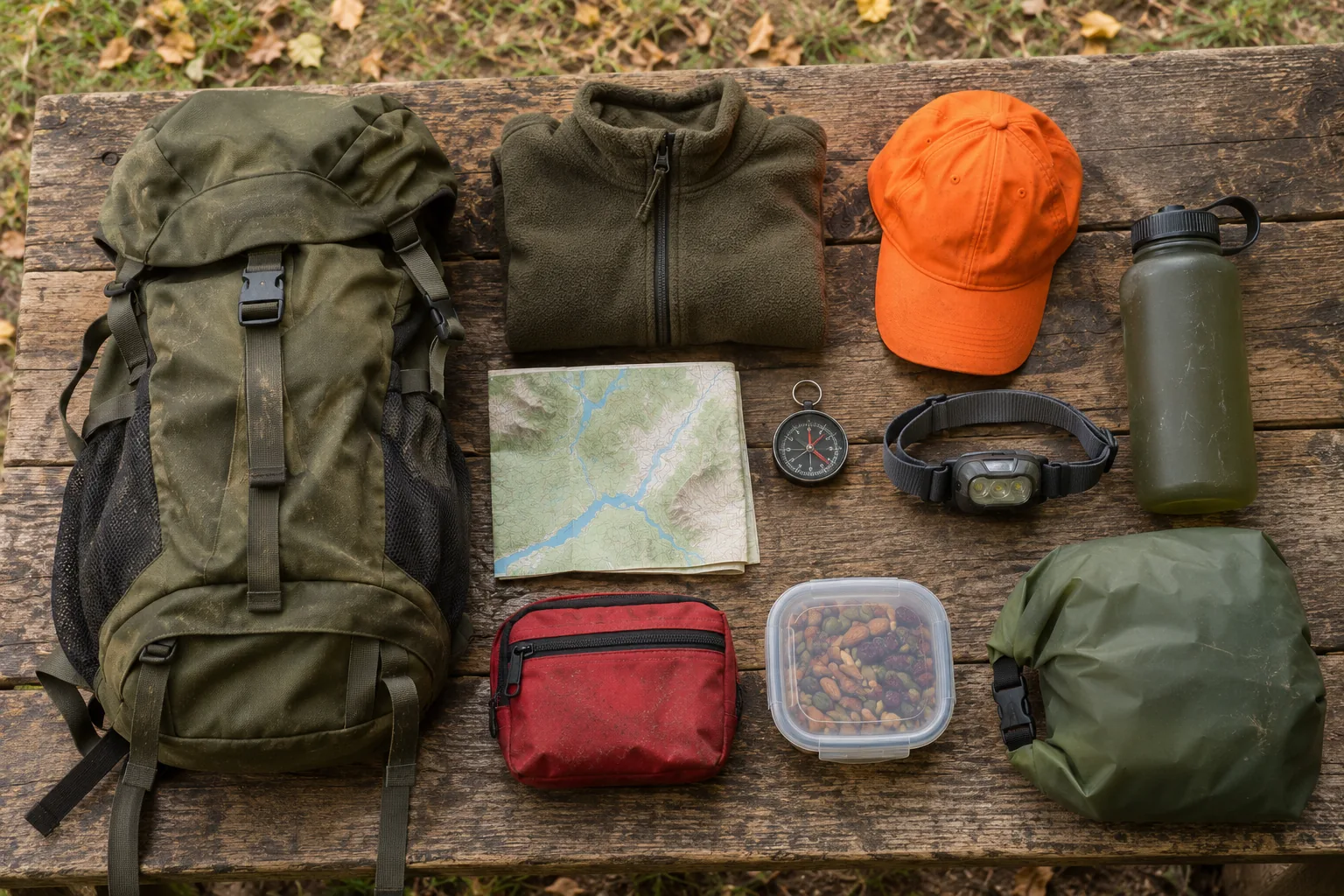
Turn equipment into a workable day pack. Group it by purpose, test access in your trip clothing, and expose failures when a phone, companion or return plan changes. Reduce or cancel the outing when essential checks fail.
12 min read · Checked
2026 Alberta sources and current public outdoor guidance; practical packing exercise, checked 2026-11-07
What you will be able to do
Prepare and test one personally manageable pack, distinguish carried essentials from vehicle reserves, and explain a specific go, shorten or cancel decision without treating equipment as permission or a safety guarantee.
Separate the rule layers
- Alberta / provincial
- A packed bag does not establish an open season, lawful route or site access. Check your actual Alberta licence, physical tags when required, species, date, WMU and current site conditions. The Guide distinguishes carrying an approved electronic licence from carrying a tag. A printed checklist cannot replace either.
- Canada / federal
- Firearms documents and transport obligations, and any federal migratory-bird permit, remain separate checks for the actual person and activity. This packing rehearsal teaches no weapon operation, handling technique or medical treatment; use the relevant official guidance and qualified training.
- Field practice / planning suggestion
- The grouping and reach tests below are planning suggestions, not a complete equipment standard or a certification. Adapt them to the route, season, group and your abilities. Keep private contacts, documents and exact personal locations in your own records; the exercise needs invented details only.
Pack and prepare
- Your actual day pack and clothing, with paper placeholders for sensitive documents and weapon-specific checks.
- Current route references, an offline map, paper backup and the navigation tools you know how to use.
- Suitable extra layers, emergency communication and shelter, light and working backup power for the actual outing.
- Food, safe drinking water and separately considered return reserves that suit the people and conditions.
- Clean suitable recovery containers and a private note sheet for missing items, access checks and test results.
Adapt this starter list to the actual site, season, group and activity. It is not a complete equipment standard.
Work through the outing
STEP 01
Lay out one outing, not every possible adventure
Start on a clean floor with the date, intended activity, lawful route, expected walking time and return margin written beside the empty pack. Include every participant’s ordinary needs, not just the person who owns the equipment. Lay out what will be worn, carried and left in the vehicle as three separate areas. Leave firearms and ammunition outside this indoor exercise; use a paper placeholder for their separate trained checks. Put the real document question first: which licence format and physical tags must accompany this person? The 2026 Guide accepts the AlbertaRelm APP as the electronic alternative to paper licences and says tags cannot be carried electronically. A photograph of a tag is not the tag. Test access to the permitted format and required physical items, rather than assuming a booking receipt or a saved web page will do. Open the current site instructions and unresolved access notes before choosing the walking objective. If the legal or land question is unanswered, the correct pack does not make the hunt ready.
STEP 02
Group equipment by the job it must do
Make five working groups: documents and location; warmth and shelter; communication and light; food and water; and return or recovery. These are organising labels, not an official five-item survival standard. Ask what each item does, who carries it, when it will be needed and whether it still works wet or cold. Alberta Parks recommends maps, appropriate clothing, food, water, lighting and emergency shelter, and warns that cellular service is absent in many areas. Download the actual map area and relevant current instructions before departure, with a paper backup and a compass you understand. A downloaded basemap is not a legal boundary survey or proof that a route is open. Match layers to the hours you may actually be outside, including a slow return, not just the sunny arrival. Put the planned emergency communication method beside the navigation group and read its operating instructions. An unused satellite device, an uncharged phone or a cable that fits no device cannot fill the role written on the label.
STEP 03
Test the real wearing and reach sequence
Put on the walking layers, gloves and full pack at home. Adjust the load and practise ordinary movements without a weapon: walk, bend, remove a layer and retrieve the map, light and communication device. A companion can watch for a strap trapping a pocket or a shell covering an item. Close the bag and repeat; a successful test with everything already on the table proves little. Use airplane mode to open the downloaded map and instructions, locate the planned area and explain what the displayed position can and cannot establish. Check the light, spare power and actual cable together, including whether gloves make controls unusable. For bear-country equipment, follow the official guidance and product label: bear spray belongs accessible in a suitable hip or chest holster, not buried in the pack. Rehearse only safe access with an inert training substitute; do not discharge a live canister or activate an emergency signal for this exercise. Practise skills with qualified instruction rather than treating this packing lesson as training.
STEP 04
Expose what fails when plans or people separate
Review the pack as a group without deliberately separating outdoors. Imagine that the person carrying the shared power bank has to return, a bag is temporarily unavailable, or an ordinary message receives no reply. Who still has the agreed navigation, light, warmth and way to seek help? Keep the group together and use the prearranged regrouping and overdue plan; do not improvise a search across an unknown boundary. Share roles explicitly and avoid making one person’s pocket the only place every essential is stored. Leave the detailed itinerary and check-in instructions privately with the trusted return contact. A delivered message is not proof that someone can assist. Reserve food, drinking water, light power and usable warm layers for the return and a plausible delay, rather than planning to use everything before turning around. There is no universal quantity in this lesson: conditions, exertion and individual needs differ. Vehicle supplies are a separate reserve and do not solve a missing item when the vehicle is hours away.
STEP 05
Check food, water and the return space
Open the food and water group, not just its shopping list. Check that containers close, drinking water is available and the food suits the actual day without a cooling arrangement you cannot maintain. Alberta Health Services advises not assuming lake, stream or spring water is safe; carrying an untested filter is not a completed drinking-water plan. Follow current official water guidance and the equipment instructions without inventing a treatment shortcut. Keep food and drink separate from dirty recovery items and allow for waste coming back out. Lay out clean suitable recovery containers and confirm that they fit with the ordinary return load. Gloves and hand hygiene belong to the relevant wildlife-health guidance; the packing exercise teaches no dressing procedure. Required tags, identification and transport or reporting documents must remain available under the rules for the actual animal. A container is not a cooling method, and an empty bag does not establish that you can carry a harvest lawfully or promptly. If the recovery plan exceeds the people, route or time available, reduce the objective before departure.
STEP 06
Make the departure decision with the packed load
On the day, reopen the official forecast, alerts, road and closure information for the actual place. Compare the packed layers and return margin with those conditions and everyone’s ability, not yesterday’s confidence. Walk briefly in the ordinary safe setting with the full load and identify what you cannot manage or retrieve. Remove optional duplication, not the water, lighting or communication needed for the agreed return. If essential capacity is missing, choose a shorter lawful outing, change the date or cancel; an overloaded pack does not justify a prohibited vehicle route. Recheck the reachable light and power before leaving the vehicle, and confirm the private return contact has the final plan. A navigation light is for the separate return task under applicable rules, not an extension of hunting hours or a means of hunting with light. End hunting early enough to preserve that return. Afterwards note one missing item, one inaccessible item and one unnecessary item, then repair the arrangement before the next outing.
Common mistakes to catch
Counting shared or vehicle equipment as if it were in your pocket
Name the carrier and the task. One charged phone does not give every person a reachable light, offline map or return reserve. Correct the group plan without deliberately splitting up, and keep vehicle backups distinct from what remains with the walkers.
Solving a failed pack test by abandoning the return margin
Do not remove essential return supplies to preserve an ambitious hunting distance. Remove optional extras or reduce the outing. Unresolved entry, unsafe conditions, inaccessible emergency equipment or an unworkable recovery load remain reasons to postpone or cancel, not invitations to improvise a shortcut.
PRACTISE BEFORE YOU GO
Run a fictional missing-pocket rehearsal
An invented pair plans a short outing on an already researched lawful route. At the kitchen table, place a paper map placeholder, light, gloves, water and clean container with the real pack. One person’s fictional phone loses service, the shared cable does not fit and a spare layer is behind everything else. Later, the person carrying the shared reserve must return early. Mark each item as worn, carried or vehicle-only, then repeat the reach test with gloves and an offline map. Explain what must change, what stays with the walking group and whether a shorter outing or cancellation is needed. Use clean placeholders and invented contact details; do not send an emergency signal, separate outdoors or publish real documents and locations.
Use a hypothetical location for the exercise. Keep real contact details, licence numbers and exact private locations in your own private records.
Check your understanding
The pack contains every listed item, but the offline map will not open and the only return light is in a companion’s vehicle. What should you do?
- Depart because a complete checklist proves the equipment plan is sufficient.
- Correct and retest the actual navigation and reachable light; shorten, postpone or cancel if the essentials remain unworkable.
- Remove return water to make room for another gadget and rely on finding a signal later.
Show the answer and explanation
B. Correct and retest the actual navigation and reachable light; shorten, postpone or cancel if the essentials remain unworkable.
Presence is not function or access. The test must show that the actual people can use the necessary equipment under their planned conditions. A map failure and unreachable light must be resolved before departure; a checklist, vehicle reserve or extra gadget grants neither navigation capacity nor land permission.
This is a learning exercise, not a licence exam or a finding of legal eligibility.
Official sources and editions
The lesson is written for this site. The links below let you verify the underlying rules and current notices; they are not copied lesson text or permission to access land.
- Alberta Guide — Licensing & Costs ↗ — 2026 Alberta Hunting Guide · Checked 2026-11-06
- RCMP — Licensing information ↗ — Current federal guidance; checked 2026-11-06 · Checked 2026-11-06
- Alberta Guide — General regulations ↗ — 2026 Alberta Hunting Guide · Checked 2026-11-06
- Alberta — Public land closures ↗ — Live official notices; check again before departure · Checked 2026-11-06
- ECCC — Migratory bird hunting summary: Alberta ↗ — August 2026–July 2027 · Checked 2026-11-06
- Alberta Parks — Hiking and backcountry safety ↗ — Official page updated 2026-09-24 · Checked 2026-11-06
- Alberta — Winter recreation on public land ↗ — Current official guidance; checked 2026-11-06 · Checked 2026-11-06
- ECCC — Alberta weather and alerts ↗ — Live official forecasts and alerts · Checked 2026-11-06
- 511 Alberta — Official travel information ↗ — Live official road information · Checked 2026-11-06
- Alberta Guide — Big game regulations ↗ — 2026 Alberta Hunting Guide · Checked 2026-11-06
- Alberta BearSmart — Deterrents: bear spray and noisemakers ↗ — Current official product, training and carrying guidance; checked 2026-11-06 · Checked 2026-11-06
- Alberta Parks — Advisories and Public Safety ↗ — Live official site notices; checked 2026-11-06, recheck before departure · Checked 2026-11-06
- My Wild Alberta — Harvested Wildlife and Human Health ↗ — Official page updated 2023-10-18; checked 2026-11-06; current health questions require the appropriate authority · Checked 2026-11-06
- Alberta Health Services — Packing food for the backcountry ↗ — Safe Healthy Environments; current as of 2025-07-21; checked 2026-11-07 · Checked 2026-11-07
- Alberta Health Services — Drinking water in the backcountry ↗ — Safe Healthy Environments; current as of 2025-07-21; checked 2026-11-07 · Checked 2026-11-07
Make one plan you can review
Published seasons and conditions → · Visitor eligibility and accompaniment →