ALBERTA / BEGINNER FIELD GUIDE
Hunter orange and shared land in Alberta: visibility, site rules and clear decisions
Build a visibility plan that works with your real pack, companions and route. Separate official advice from a specific site requirement, then practise communication, encounters and an early lawful return without relying on clothing to identify a target.
17 min read · Checked
2026 Alberta Guide; 2026 Draws printed p18 Wainwright example; current Parks/ACA guidance checked 2026-11-07
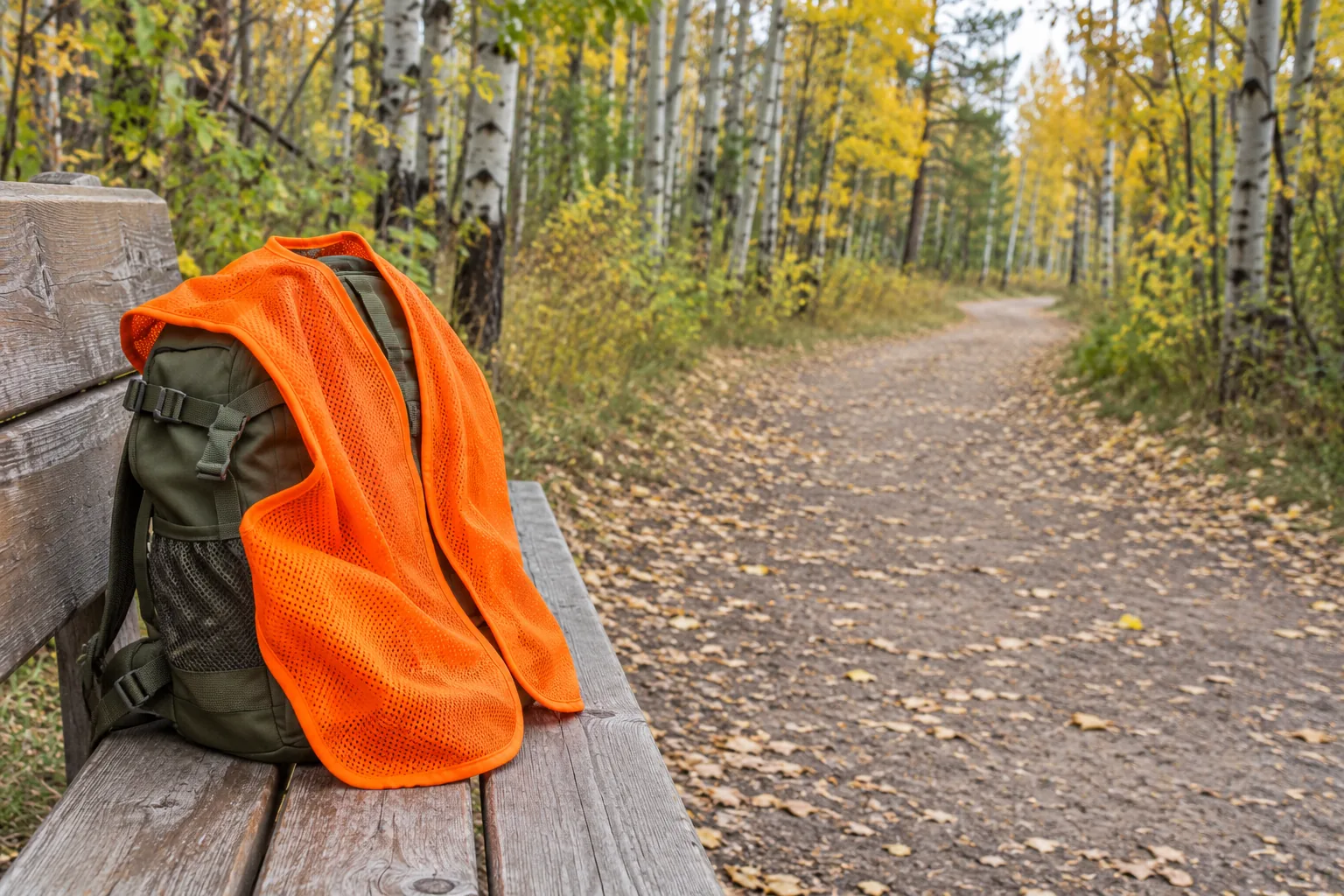
What you will be able to do
Explain what your clothing can help with, what the actual rules require, and which uncertainty makes the group pause or stop regardless of colour.
Separate the rule layers
- Alberta / provincial
- Do not import Saskatchewan or another province’s clothing rules into Alberta. Read the current Alberta Guide, actual licence and any site permit or activity instructions. This lesson supplies no province-wide orange area, colour specification or blanket exemption; a local requirement must be checked in its own scope.
- Canada / federal
- Visibility clothing does not replace applicable federal firearms training, licensing or transport requirements. Practise equipment handling through the appropriate qualified instruction; the exercises here concern observation, communication, clothing and route decisions.
- Field practice / planning suggestion
- The pack test, group agreement and earlier stop decisions below are practical learning suggestions. They are not legal approval or a promise that another user can see you. Every hunter remains responsible for positive identification and the real surroundings.
Pack and prepare
- A conspicuous outer layer and head covering suited to the trip and any actual site requirement
- The real pack, rain layer and spare dry clothing for a visibility-and-fit check
- Offline route and boundary maps, relevant site conditions and your own documents
- Tested communication, navigation light and a private contact-and-return plan
- Binoculars, water, basic first-aid supplies and a short notebook checklist
Adapt this starter list to the actual site, season, group and activity. It is not a complete equipment standard.
Work through the outing
Common mistakes to catch
Using another province’s rule or one site’s exception as a universal answer
Attach the actual jurisdiction, activity, people and area to every requirement. The Wainwright example does not set WMU 936 clothing conditions, and its designated bow-area exception is not an Alberta-wide bowhunter exemption. An official safety recommendation also does not become a mandatory area measurement when copied into a checklist.
Treating visible clothing or a radio message as complete situational knowledge
Someone can be obscured, move after a message or wear ordinary outdoor clothing. Stop when identity, background or group location becomes uncertain; do not assign responsibility to others for failing to wear your chosen colour. Re-establish the plan from a lawful place, or end the outing if that cannot be done.
PRACTISE BEFORE YOU GO
Fictional shared-trail rehearsal: the vest is not the answer
An invented group has checked its licences and proposed site but has not yet completed its clothing and communication plan. A rain shell covers one person’s bright vest, another person’s pack hides the rear panel, and a radio message gives an old meeting position. Near a trail junction, a rider and controlled dog approach as daylight fades; movement beyond the junction cannot be identified. On paper, fill the three source-scope columns, test the real clothing combination at home and specify a calm pause/regroup/return decision. Explain why neither the missing orange nor the radio message resolves who is beyond the junction. Add a Wainwright ungulate-hunt requirement as a separate document exercise, without applying its bow-area exception to the fictional site. Finish with the allowed return route and a private contact update. Do not invent a real entrance or publish personal locations.
Use a hypothetical location for the exercise. Keep real contact details, licence numbers and exact private locations in your own private records.
Check your understanding
Bright clothing meets the planned site condition, but a companion’s position and the background are uncertain. What is appropriate?
- Continue because compliant clothing makes the area safe and everyone else should also wear orange.
- Pause the hunting proposal, resolve identity and positions through the agreed plan, and end or return if uncertainty persists.
- Follow the movement to regain sight, even across an unconfirmed boundary.
Show the answer and explanation
B. Pause the hunting proposal, resolve identity and positions through the agreed plan, and end or return if uncertainty persists.
Visibility equipment is one layer of preparation, not proof of identity, an empty background or permission. The hunter must resolve the actual situation, keep other users safe and preserve a lawful exit. A site rule, a radio update and personal confidence cannot replace those checks.
This is a learning exercise, not a licence exam or a finding of legal eligibility.
Official sources and editions
The lesson is written for this site. The links below let you verify the underlying rules and current notices; they are not copied lesson text or permission to access land.
- RCMP — Licensing information ↗ — Current federal guidance; checked 2026-11-06 · Checked 2026-11-06
- Alberta Guide — General regulations ↗ — 2026 Alberta Hunting Guide · Checked 2026-11-06
- Alberta Parks — Hiking and backcountry safety ↗ — Official page updated 2026-09-24 · Checked 2026-11-06
- Alberta — Motorized recreation on public land ↗ — Current official route and vehicle guidance; checked 2026-11-06 · Checked 2026-11-06
- Alberta Parks — Considerations for Hunters ↗ — Official guidance updated 2026-06-23; checked 2026-11-06 · Checked 2026-11-06
- Alberta — 2026 Hunting Draws: licences and maps ↗ — 2026 draw booklet, especially printed pages 28–31; checked against current Guide 2026-11-06 · Checked 2026-11-06
- ACA — 2026 Provincial Pheasant Release Sites: current notices and site search ↗ — 2026 site directory and current release-site notices; checked 2026-11-07; recheck the individual site before departure · Checked 2026-11-07
- My Wild Alberta — Safety Tips for Non-Hunters ↗ — Official advice for non-hunters; page updated 2023-11-21, checked 2026-11-07; not a new clothing regulation · Checked 2026-11-07
- Alberta Parks — Cooking Lake-Blackfoot PRA Hunter Information Package ↗ — WMU 936 site guidance updated 2026-09-25; checked 2026-11-07; consult current permit and notices · Checked 2026-11-07
Make one plan you can review
Published seasons and conditions → · Visitor eligibility and accompaniment →